Build manual · Deep water culture · Fruiting crops
DWC Cherry Tomato: one plant, 25 L, 600 PPFD, and a daily top-up habit
A single indeterminate cherry tomato in deep water culture is the highest-yield plant per square metre you can grow indoors, and the least forgiving. It will drink four litres a day at peak, and every failure mode is a consequence of missing a check.
- Reservoir
- 25 Lworking volume
- Planting sites
- 1sites
- Pump
- 120 GPH454 L/h
- Air stones
- 2stones
- EC target
- 2 mS/cmtarget
- pH window
- 5.8 - 6.2pH
- Light at canopy
- 600 PPFDat leaf
- Photoperiod
- 16 hper day
- Cycle length
- 110 daysplant to harvest
Top-up routine — A single cherry tomato in a 25 L DWC can drink 3-4 L per day at peak; check daily and top to the mark with 2.0 mS/cm nutrient.
| Part | Specification | Qty | Substitute |
|---|---|---|---|
| Reservoir | 25 L opaque bucket with lid, 35 cm diameter | 1 | A 20 L bucket works but the daily draw at peak leaves almost no margin |
| Net pot | 100 mm rim, deep basket | 1 | A 75 mm pot is enough if you plant a determinate variety rather than a sprawling one |
| Air pump | Dual outlet, 3 W, 2 x 1.5 L/min | 1 | A single 60 L/h pump with one large bar stone is acceptable but less even |
| Air stones | 5 cm round, fine pore, opposite corners | 2 | A 15 cm bar stone laid across the bottom covers a 35 cm diameter well |
| Growing medium | LECA 8-16 mm, 3 L | 3 L | Rockwool cube in a LECA collar holds the stem steadier for a tall plant |
| Cherry tomato seedling | 5 weeks, indeterminate, first truss visible | 1 | A determinate bush type keeps the plant under 1 m in a tent |
| Fruiting nutrient | Two-part high K, 2.0 mS/cm | 1 L each | Dry salts: 1.8 g/L calcium nitrate plus 0.9 g/L potassium sulfate at peak |
| Trellis | 1.8 m stake plus 3 m of soft twine | 1 | A yo-yo hanger clipped to the tent frame lets you lower the plant as it grows |
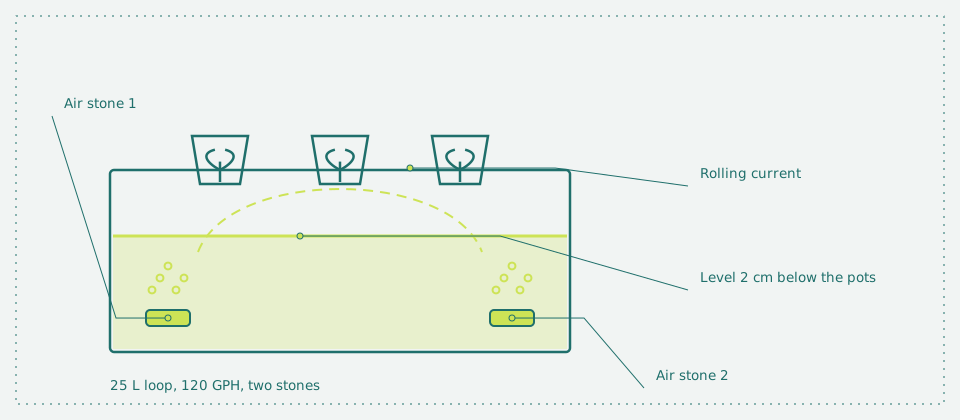
Set the water 2 cm below the pot base, not touching
A single large plant in a 25 L bucket has a big root mass and does not need the pot sitting in water after the first week. Run the initial level 2 cm below the net pot, let the airstones throw moisture into the gap, and the roots will reach down on their own within four days with far less risk of stem rot.
Two stones at opposite corners, always
One stone under a tomato plant that is drinking 4 L a day creates a single oxygenated column and a large dead zone on the far side. Two stones at opposite corners of a 35 cm bucket keep the whole volume turning over, which matters more here than in a shallow tote because the water column is deeper.
Start at 1.4 and reach 2.0 by the third truss
A cherry tomato in DWC grows explosively and it is tempting to feed it hard from the start. Resist it. 1.4 mS/cm until the first truss sets, 1.7 at the second, 2.0 from the third onwards. A plant pushed early produces a huge vine with sparse, poorly filled trusses.
Remove every side shoot below the third truss
An indeterminate cherry tomato in a tent will produce a side shoot at every leaf axil. Removing them all below the third truss and then weekly above it keeps the plant as a single productive vine and dramatically improves airflow, which is the main defence against botrytis in a still tent.
Shake the trusses to set fruit
Indoor tomatoes have no wind. A gentle flick of each open truss with a finger at midday releases the pollen and is the difference between a full truss of evenly sized cherries and one with half the flowers dried and dropped. Do it every day while a truss is in flower, for about a week.
Change the reservoir every two weeks at peak
On a single plant drinking 4 L a day, the 25 L reservoir turns over completely in under a week. Root exudates accumulate fast at this rate, so a full dump-and-recharge every two weeks during fruiting keeps the root zone clean. Waiting for a visible problem means waiting until the roots are already brown.
Week 1-3
EC 1.4 · pH 6.0
- Level 2 cm below the pot
- Remove side shoots below the first truss
- Shake trusses at midday
Week 4-7
EC 1.7 · pH 6.0
- Reach 1.7 at the second truss
- Keep only one vine
- Top up every 2 days
Week 8-13
EC 2.0 · pH 6.1
- Full EC during fruiting
- Daily top-up
- Reservoir change every 2 weeks
Week 14-16
EC 1.8 · pH 6.1
- Stop the vine two trusses above the last set fruit
- Continue harvesting
- Final flush in the last week
The reservoir turns over in under a week
Nobody warns you how fast a fruiting cherry tomato empties a bucket. University of Arizona CEAC puts mature greenhouse plants at roughly 4 liters per plant per day, and a DWC reservoir catches that full load — you end up topping up most days, not once a week. Top up with plain water and the EC slides south while the plant is still asking for full strength. For scale: commercial greenhouses fertigate at 2.5-3.5 mS/cm with the drain running about a unit higher, hold the root zone near pH 6.0, and feed N 200, P 50, K 360, Mg 45, Ca 185 mg/L (all University of Arizona CEAC). You can't copy those figures straight into a bucket, but the message carries over — a half-diluted reservoir is not feeding a plant that is setting fruit. Change the solution on a schedule instead of waiting for it to look wrong.
One vine, not a bush
Indeterminate cherry tomatoes do not politely stay small. Give one free rein in a tent and it becomes a multi-stemmed thicket that shades its own lower trusses, and the fruit that does set comes in small. I have grown it both ways: the unpruned plant looks magnificent in week five and slightly embarrassing by week nine. Keep one leader, snap side shoots out weekly while they are still soft, and you get something you can actually manage — trusses stacked up a stake, each one sitting in light. Light is the part people underestimate: fruiting hydroponic crops like tomatoes want 8-10 hours of sun a day (SARE), and they do best at 21-27 C by day with 16-21 C at night (University of Illinois Extension). An open canopy also moves air, which is most of the reason botrytis stays away.
Pollination is a job, not an afterthought
Tomato flowers are self-fertile, but the pollen sits locked in a cone that only lets go when something shakes it. Outdoors the wind and the bees do that for free. In a still tent, nothing does — a whole truss of open flowers can simply drop without setting. The fix is almost funny: at midday, when the air is driest, flick each open truss with a fingertip or tap the stake with a pen. An electric toothbrush pressed against the truss works too; the buzz is what matters, not the brand. In our tent the tapped trusses set visibly more fruit than the ones we left alone — nowhere near every flower, but the gap shows up on the scale at harvest. Skip it and you get rows of yellowed, empty trusses.
The airstones carry the whole system
In a deep column the bubbles are the only route oxygen has to the bottom of the bucket. A scaled-up stone still looks fine from above: bubbles rise, the surface ripples, nothing seems wrong. What you cannot see is dissolved oxygen falling away down at the root mass, and the lower roots are the ones feeding the fruit, so they are the first to stall. That is why I run two stones rather than one — not for extra volume, just insurance — and why I pull them for a scrub as soon as the bubbles feel coarse or the stone goes slick. A plant pulling close to 4 liters a day (University of Arizona CEAC) is also pulling a lot of oxygen. Air deserves the same attention you give nutrients.
Key points
- One plant drinks 3-4 L a day at peak; check and top up daily
- Keep a single vine and remove side shoots weekly
- Start at 1.4 mS/cm, reach 2.0 by the third truss
- Flick each flowering truss at midday to set fruit
- Full reservoir change every two weeks during fruiting
Sources
- Wageningen UR — https://edepot.wur.nl/403804
- Korean Journal of Horticultural Science — https://koreascience.kr/article/JAKO199911922406644.do
- University of Arizona CEAC — https://ceac.arizona.edu/sites/default/files/Chapter%2010.pdf
- University of Illinois Extension — https://extension.illinois.edu/sites/default/files/illinois_extension_hydroponics_handouts.pdf
Please noteEC, pH and light values are general home-system references and vary with variety, climate and nutrient brand. Follow the product label. This article is informational and is not professional horticultural advice.
- Dutch Bucket Tomatoes: two indeterminate plants, 60 L of reservoir, 17 weeks of harvest · Build manual · 5 Sept 2026
- DWC Basil Tote: 20 L, six plants, and a pump that quietly decides everything · Build manual · 20 Aug 2026
- Kratky Lettuce Bucket: a 12 L no-pump system that runs 35 days on one charge · Build manual · 11 Aug 2026
- NFT Lettuce Rail: two 1.8 m channels, 24 plants, 30 days from plug to plate · Build manual · 28 Aug 2026