Nutrient chart · Herbs
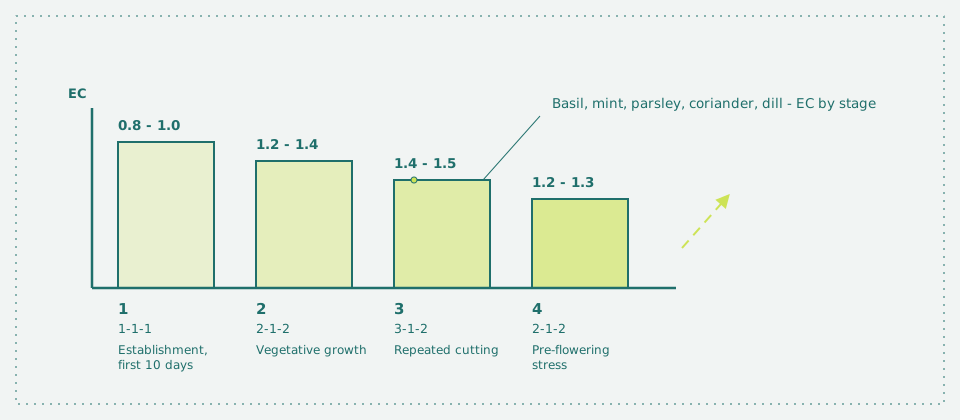
Soft Herb EC and pH Chart by Stage: basil, mint, parsley, coriander, dill
Soft herbs are light feeders compared with fruiting crops, but they are the group where overfeeding does the most visible damage: burnt leaf margins, tough texture, and a flavour that turns bitter and soapy. The stage that catches most people is the one after repeated cutting.
| Stage | EC | pH | N-P-K | Notes |
|---|---|---|---|---|
| Establishment, first 10 days | 0.8 - 1.0 | 5.8 - 6.0 | 1-1-1 | Cuttings and transplants both stall above 1.2 in this window |
| Vegetative growth | 1.2 - 1.4 | 5.9 - 6.2 | 2-1-2 | Basil takes the top of the range, parsley and dill the bottom |
| Repeated cutting | 1.4 - 1.5 | 6.0 - 6.2 | 3-1-2 | Every cut removes nitrogen with the tissue; EC must be maintained, not coasted |
| Pre-flowering stress | 1.2 - 1.3 | 6.0 - 6.3 | 2-1-2 | A slight drop and extra magnesium slows bolting in coriander and dill |
Herbs are cut, so they lose nitrogen with the harvest
A lettuce plant is harvested once; a basil plant is cut every week for two months. Every cut removes leaf tissue and the nitrogen inside it, and unlike a fruiting plant the herb has no large reserve to draw on. That is why the EC for a repeatedly cut herb should sit higher than for a herb that is simply growing: 1.4-1.5 mS/cm maintains the plant instead of letting it coast down.
Coriander and dill bolt on low nitrogen and warm roots
Coriander and dill both respond to stress by flowering, and the stress that triggers it most reliably is a warm root zone combined with declining nitrogen. Keeping the solution under 21 C and the EC at 1.2-1.3 rather than letting it fall to 0.8 delays bolting by roughly two weeks, which is the difference between a usable crop and a pot of flowers.
Mint and parsley want the low end of every range
Mint and parsley are both tolerant plants that grow well on very little. In a small Kratky jar at 1.1 mS/cm they will produce for two months; at 1.6 the mint stops producing runners and the parsley leaf tips burn. The general rule for soft herbs is that if the plant looks healthy and the EC reads above 1.4, the reading is more likely to be the problem than the plant.
Magnesium is the herb deficiency nobody expects
On soft water, herbs in small reservoirs show magnesium deficiency before anything else: older leaves go yellow between the veins while the veins stay green, and it moves upward. It appears because the standard herb formula assumes tap water contributes magnesium. Adding 0.1 g/L of Epsom salt to soft water corrects it, and it is worth checking before adjusting anything else.
Key points
- Establish at 0.8-1.0 mS/cm; herbs stall above 1.2 in the first ten days
- A repeatedly cut herb needs 1.4-1.5, not the growth-stage figure
- Coriander and dill bolt sooner on warm roots and falling nitrogen
- Mint and parsley do best at the bottom of every range
- On soft water add 0.1 g/L Epsom salt for magnesium
Sources
- Korean Journal of Horticultural Science — https://koreascience.kr/article/JAKO199911922406644.do
- University of Padova — https://thesis.unipd.it/retrieve/cf7c45ea-4318-4977-aeeb-b05a8217ce63/Flaim_Gabriel.pdf
- SARE — https://projects.sare.org/wp-content/uploads/Leafy-Greens-Hydroponic-publication2022.pdf
- University of Illinois Extension — https://extension.illinois.edu/sites/default/files/illinois_extension_hydroponics_handouts.pdf
Please noteThe EC, pH and ratio values are general references for soft herbs and vary with cultivar, water supply and nutrient brand. Mix to your product label. This is informational content and not professional horticultural advice.
- DWC Basil Tote: 20 L, six plants, and a pump that quietly decides everything · Build manual · 20 Aug 2026
- Kratky Herb Jars: three 1 L windowsill jars that beat a supermarket pot by week six · Build manual · 15 Sept 2026
- Leafy Green EC and pH Chart by Stage: lettuce, mizuna, tatsoi, pak choi · Nutrient chart · 14 Aug 2026