Nutrient chart · Microgreens
Microgreen EC and pH Chart: 12 days on almost no nutrient at all
Microgreens are the only hydroponic crop where the correct nutrient answer is close to none. The seed supplies everything the plant needs for the whole cycle, and the reservoir exists mainly to keep the growing mat uniformly damp rather than to feed anything.
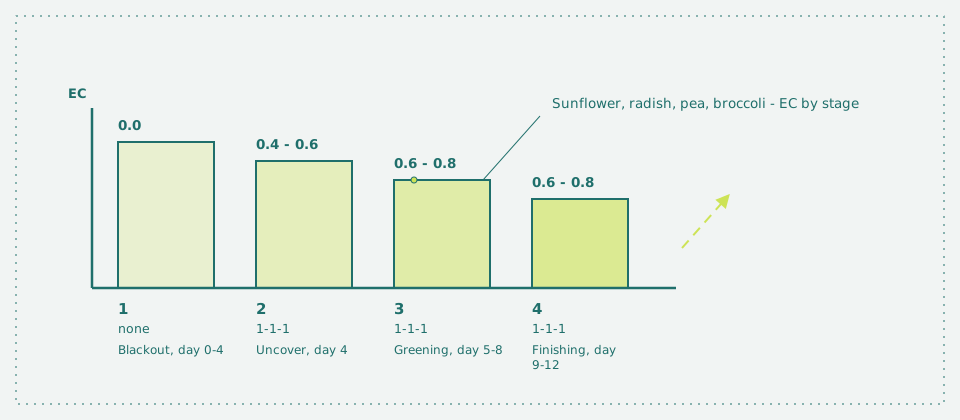
| Stage | EC | pH | N-P-K | Notes |
|---|---|---|---|---|
| Blackout, day 0-4 | 0.0 | - | none | Plain water only; the mat needs moisture, not nutrition |
| Uncover, day 4 | 0.4 - 0.6 | 6.0 - 6.3 | 1-1-1 | The seed reserve still covers growth; a light charge simply keeps the water stable |
| Greening, day 5-8 | 0.6 - 0.8 | 6.2 - 6.5 | 1-1-1 | Photomorphogenesis begins; the plant photosynthesises but still lives on reserve |
| Finishing, day 9-12 | 0.6 - 0.8 | 6.2 - 6.5 | 1-1-1 | Do not raise the EC to chase size; it produces tip burn and bitterness |
The seed reserve is the fertiliser
A sunflower seed contains roughly 45-50 % oil and enough stored protein and minerals to push a stem 10-12 cm and unfold two full cotyledons without any external input at all. Growers who run microgreens on plain water for the full twelve days get excellent results. The 0.4-0.8 mS/cm charge in this chart exists because tap water plus a trace of nutrient buffers pH better than pure water and keeps the mat's moisture behaviour consistent from batch to batch.
Why pushing the EC backfires
Above about 1.0 mS/cm, microgreens start showing tip burn on the cotyledon edges within three days, and the flavour of radish and broccoli turns harsh. The mechanism is simple: the plant is not transpiring much at this stage and it has no root system to buffer salt concentration, so whatever is in the water is what the cotyledon sits in. There is no yield benefit to chase, because the size of a microgreen is set by the size of its seed, not by nutrition.
pH is a different story, and higher is fine
Microgreens are one of the few crops that do perfectly well at pH 6.5 and even slightly above. Because the plant is not relying on solution nutrients, lockout at higher pH does not matter. What does matter is that pH stays stable across the twelve days, because swings in a shallow tray mean swings in moisture wicking, and uneven wicking means uneven germination.
Water quality is the real variable
The single number that changes a microgreen batch most is the starting EC of the water. Tap water at 0.5 mS/cm already provides more mineral content than a microgreen can use, and adding a nutrient charge on top of it can double the total. On that supply, use plain water. On soft water below 0.1 mS/cm, the 0.4-0.6 mS/cm charge is worth adding to stabilise pH.
Key points
- Plain water is genuinely fine for the whole 12-day cycle
- Keep the charge at 0.4-0.8 mS/cm; above 1.0 the cotyledons burn
- Size comes from the seed, not from nutrition; there is no yield to chase
- pH 6.2-6.5 is acceptable and stability matters more than the value
- Check the starting EC of your tap water before adding anything
Sources
- Korean Journal of Horticultural Science — https://koreascience.kr/article/JAKO199911922406644.do
- University of Padova — https://thesis.unipd.it/retrieve/cf7c45ea-4318-4977-aeeb-b05a8217ce63/Flaim_Gabriel.pdf
Please noteThese values are general references for home microgreen production. Follow any seed supplier's food-safety guidance, and treat this article as informational rather than professional food-safety or horticultural advice.
- Kratky Microgreen Tray: sunflower and radish in 12 days on 8 mm of solution · Build manual · 28 Sept 2026
- Leafy Green EC and pH Chart by Stage: lettuce, mizuna, tatsoi, pak choi · Nutrient chart · 14 Aug 2026
- Lettuce Head Finish Chart: what changes in the last ten days · Nutrient chart · 30 Sept 2026