Build manual · Nutrient film technique · Leafy greens
NFT Baby Leaf: three 1.2 m rails, 45 sites, a 21-day turnaround you can repeat all year
Baby leaf is the crop that makes a small NFT system worth running. The cycle is 21 days, the plants never get large enough to clog anything, and three short rails in a tent will produce a mixed salad every three weeks indefinitely. Almost everything about the design is driven by that short cycle.
- Reservoir
- 45 Lworking volume
- Planting sites
- 45sites
- Pump
- 180 GPH681 L/h
- Air stones
- 1stones
- EC target
- 1 mS/cmtarget
- pH window
- 5.8 - 6.2pH
- Light at canopy
- 180 PPFDat leaf
- Photoperiod
- 14 hper day
- Cycle length
- 21 daysplant to harvest
Top-up routine — A 21-day baby leaf cycle barely moves the reservoir; check EC weekly, top up 2-4 L with 1.0 mS/cm solution, and do a full change between cycles.
| Part | Specification | Qty | Substitute |
|---|---|---|---|
| NFT channels | 1.2 m extruded channels, 75 x 50 mm, 15 planting sites each | 3 | Halved 68 mm downpipe with 45 mm holes at 8 cm centres |
| Reservoir | 45 L opaque tote | 1 | 35 L is fine for three short channels on a 21-day cycle |
| Pump | 700 L/h, 10 W | 1 | A 500 L/h pump with a manifold feeding all three rails in parallel |
| Manifold | 19 mm PVC with three 8 mm outlets and a ball valve | 1 | Flexible 13 mm poly tube with two tees and a clamp on each leg |
| Net pots | 28 mm, 45 total | 45 | Rockwool mini-cubes pushed straight into the channel holes for a soil-free start |
| Growing medium | Fine LECA 4-8 mm | 2 L | Rockwool cubes alone are cleanest for baby leaf because there is no medium to wash into the filter |
| Baby leaf seed | Mizuna, rocket, red mustard, kale, 3 g per rail | 9 g | Pelleted seed costs more but saves an hour of thinning |
| Nutrient | Two-part leafy formula, 1.0 mS/cm | 500 mL each | A single-part lettuce blend at half the label strength |
Sow into the channel, not into pots
Baby leaf crops are harvested at 10-12 cm before the roots have any chance to fill a net pot, so a 28 mm pot is already generous. Dropping two seeds into each channel site and thinning to one at day 4 removes an entire transplant step and gives a more even stand.
Keep the film shallow and the spacing tight
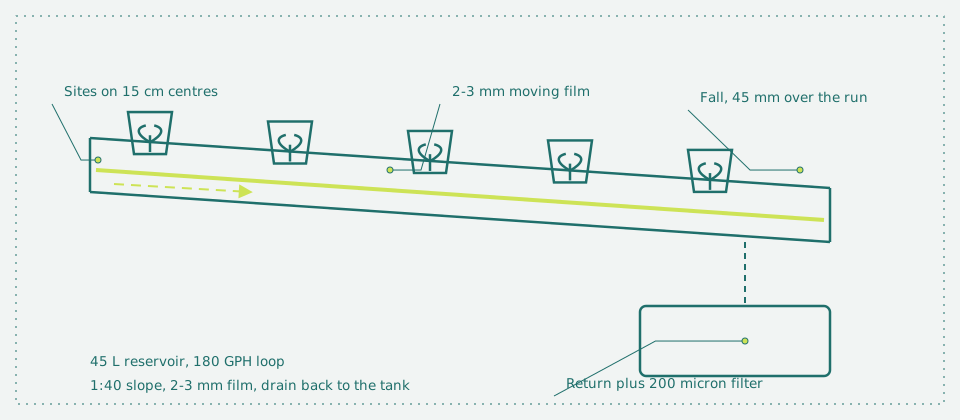
Baby leaf wants a 2 mm film rather than the 3 mm that suits head lettuce, because the root systems are thin and short. Sites at 8 cm centres are close enough that the canopy closes by day 12, which shades the channel and suppresses algae. Wider spacing means more light reaches the film and you will be cleaning green slime off it by day 8.
Run 1.0 mS/cm for 21 days, no more
A 21-day crop never needs a heavy charge. At 1.0 mS/cm the leaves stay tender and the flavour stays mild; at 1.5 the rocket turns peppery to the point of unpleasant and the mizuna leaves go leathery. Because the cycle is so short, the reservoir only moves 2-4 L over the whole run.
Harvest the whole rail at once
Cut the entire channel at 10-12 cm with scissors or a sharp knife, 20 mm above the channel surface, in a single pass. Baby leaf does not regrow usefully from a cut like this, so there is no reason to leave anything behind. Clean the channel and sow the next batch the same day to keep the rotation tight.
Sanitise between every cycle
On a 21-day cycle you run 17 crops a year through the same channels, and any pathogen present at the end of one cycle has 17 chances to establish. A rinse with 1 % hydrogen peroxide solution, followed by a clear water flush, takes ten minutes per rail and is the single most valuable maintenance step in a baby leaf system.
Watch the light distance, not the hours
Baby leaf at 180 PPFD finishes in 21 days. Moving the light closer to speed it up produces thinner, more etiolated leaves that wilt within hours of harvest, because the plant invests in stem rather than leaf tissue. Keep the bar at the distance that gives 180 PPFD and adjust the cycle length instead.
Day 0
EC 1.0 · pH 6.0
- Sow 2 seeds per site
- Start pump 24/7
- Film at 2 mm
Day 1-4
EC 1.0 · pH 6.0
- Thin to one per site at day 4
- Check the film spans the full channel width
Day 5-14
EC 1.0 · pH 6.1
- Top up 2-4 L total
- Canopy closes around day 12
- Keep light at 180 PPFD
Day 15-21
EC 1.0 · pH 6.1
- Harvest the whole rail at 10-12 cm
- Sanitise channels and reservoir
- Sow the next batch same day
What actually breaks a baby leaf rail?
Baby leaf comes off in 21 days, and a run that short flips the priority list. Over the whole batch the reservoir drops only two to four litres, so the conductivity reading barely moves and salts never get the chance to pile up the way they do in a long-season Dutch bucket. What does bite is hygiene and even emergence: a rail that gets a proper clean between batches turns out seventeen crops a year, while one that only gets rinsed carries algae or pythium into the fourth batch and keeps it there. pH asks for almost nothing — a beginner lettuce-and-greens formula is adjusted to 5.5–6.0 depending on the crop (per SARE), and this system sits in the same band.
Because the roots stay small, the film stays thin
Baby leaf roots are short and fine and never travel far from the channel floor, so a deep film is depth the roots cannot oxygenate and water you do not need. Two millimetres across the full width is the whole requirement. Sites go in at eight centimetre centres — tight enough that the canopy closes around day twelve and shades the film, and that shade is what holds algae back. Open the spacing up and light reaches the channel surface, and you are scrubbing green slime off it long before the batch is due.
Rocket leaves turn peppery at higher strength
Rocket and mizuna build more glucosinolates when the solution is charged harder, and that is where the aggressive burn comes from. Run the same varieties at a mild 1.0 mS/cm — roughly 640 ppm of dissolved salts (per University of Arizona CEAC) — and they come out sweet and tender instead. Commercial growers treat EC as a flavour dial and move it on purpose. At home, holding one low figure steady for the whole batch is what makes the mix repeatable.
The staggered rail calendar
The rhythm is what the stagger buys. Cut one rail every seven days, sow the emptied one the same afternoon, and there is always a rail a fortnight in, one a week in, and one just sown — the harvest never stops. Leave a rail standing empty for a week and you hand over a third of the year's output for nothing. Take each rail in a single pass at 10–12 cm, about twenty millimetres above the channel surface; the crop will not regrow anything worth having, so stubble buys you nothing.
Key points
- 2 mm film, 8 cm site spacing, 1.0 mS/cm for 21 days
- Sow directly into the channel; baby leaf never needs a net pot
- Harvest whole rails at 10-12 cm; nothing regrows usefully
- Sanitise channels with 1 % hydrogen peroxide between batches
- Stagger three rails seven days apart and resow the same day you cut
Sources
- Virginia Tech — https://www.hort.vt.edu/ghvegetables/documents/Hydroponics/Nutrient%20Film%20Technique%20Lettuce_LMorgan.pdf
- Wageningen UR — https://edepot.wur.nl/403804
- Korean Journal of Horticultural Science — https://koreascience.kr/article/JAKO199911922406644.do
- SARE — https://projects.sare.org/wp-content/uploads/Leafy-Greens-Hydroponic-publication2022.pdf
Please noteEC, pH and light values are general home-system references. Follow your nutrient label and any seed supplier's food-safety guidance. This article is informational and is not professional horticultural advice.
- NFT Lettuce Rail: two 1.8 m channels, 24 plants, 30 days from plug to plate · Build manual · 28 Aug 2026
- NFT Strawberry Gutter: 16 plants, 2.4 m of channel, and a slope that has to be exact · Build manual · 3 Oct 2026
- Kratky Microgreen Tray: sunflower and radish in 12 days on 8 mm of solution · Build manual · 28 Sept 2026