Build manual · Nutrient film technique · Leafy greens
NFT Lettuce Rail: two 1.8 m channels, 24 plants, 30 days from plug to plate
Nutrient film technique runs a shallow film of solution down a sloping channel while the roots sit in the humid dark above it. It is the most efficient way to grow lettuce at home but it has almost no buffer: the slope, the film depth and the return filter all have to be right before the first seedling goes in.
- Reservoir
- 40 Lworking volume
- Planting sites
- 12sites
- Pump
- 160 GPH606 L/h
- Air stones
- 1stones
- EC target
- 1.3 mS/cmtarget
- pH window
- 5.8 - 6.2pH
- Light at canopy
- 250 PPFDat leaf
- Photoperiod
- 14 hper day
- Cycle length
- 30 daysplant to harvest
Top-up routine — Check the reservoir every 3 days; a 40 L NFT loop loses 2-3 L per day at full canopy, so top up with half-strength nutrient to the marked line.
| Part | Specification | Qty | Substitute |
|---|---|---|---|
| NFT channel | 1.8 m PVC gutter, 100 x 50 mm, capped both ends | 2 | White 68 mm downpipe cut in half lengthwise also works but sags over 1.8 m unless braced every 60 cm |
| Reservoir | 40 L opaque tote | 1 | Anything 30-60 L; smaller than 30 L and the EC swings too fast between checks |
| Submersible pump | 600 L/h, 8 W, 1.2 m head | 1 | A 400 L/h pump is enough for one rail; two rails in series need the higher flow |
| Distribution manifold | 19 mm PVC with 4 mm spigots | 1 | Flexible 13 mm poly tube pushed onto a barbed tee |
| Net pots | 50 mm, 12 per rail spacing 15 cm | 24 | 28 mm pots allow tighter spacing for baby leaf but dry out faster if flow stops |
| Return line | 25 mm flexible hose with a 200 micron inline filter | 1.5 m | Skip the filter only if you never let roots grow past the pot bases |
| Two-part nutrient | Lettuce formula, 1.3 mS/cm | 500 mL each | Dry salt blend at 1.3 g/L for a 40 L fill is cheaper over a season |
| Timer | 15-minute increment, 24 h | 1 | Leave the pump on continuously if your water stays under 22 C; intermittent is for heat control |
Set the slope before you glue anything
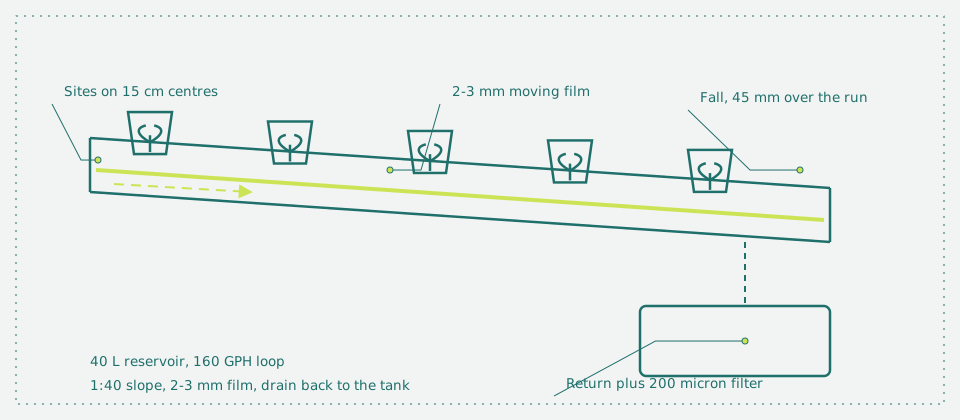
Each rail needs a 1:40 fall, which is 45 mm over 1.8 m. Put a level on the channel and pack the low end until the bubble sits just off centre. A steeper slope makes the film move so fast that the root mats stay shallow; a flat rail pools in the middle and roots drown there first.
Drill pot holes at 15 cm, offset between rails
Cut 50 mm holes on 15 cm centres, starting 12 cm from the high end so the inlet has room to spread the film. Offsetting the second rail by 7.5 cm means the two rows do not shade each other when the plants are at full size.
Tune the film, not the flow
The target is a 2-3 mm deep film across the full channel floor, which you check by looking at where the water first spans the width without touching the pot bases. If the pump delivers too much, add a ball valve on the manifold and throttle it. A full channel running 20 mm deep is no longer NFT and behaves like a badly oxygenated DWC.
Plant the high end first
The plants nearest the inlet get the freshest, most oxygenated solution and grow fastest; the far end sees depleted water. Putting the youngest seedlings at the high end and the most mature at the low end evens out the harvest, since the older plants at the tail are large enough to tolerate the weaker solution.
Guard the return with a filter
A 200 micron inline filter on the return line catches the LECA fragments and root debris that would otherwise jam the pump impeller. Check it weekly; a clogged filter starves the rails and the whole channel drains to a thin trickle within an hour.
Run the pump 24/7 unless it is hot
Continuous flow keeps the film oxygenated and the root mats cool, which is the natural strength of NFT. Only switch to 15 minutes on, 15 off when the reservoir climbs above 24 C, since a cycling pump lowers average root-zone temperature enough to slow pythium.
Week 1
EC 1.3 · pH 6.0
- Verify a 2-3 mm film across both rails
- Pump 24/7
- Check return filter twice
Week 2
EC 1.3 · pH 6.0
- Top up 3-5 L of half-strength nutrient
- Clear any root tip poking into the channel floor
Week 3
EC 1.3 · pH 6.1
- Expect 2-3 L per day of transpiration
- Raise light as canopy closes
Week 4
EC 1.2 · pH 6.1
- Harvest all 12 positions at once, highest first
- Full reservoir change before replanting
The film is the whole design
The target is 2-3 mm of moving solution across the channel floor. That depth is shallow enough that the upper half of the root mat stays in humid air and deep enough that the lower roots never dry. Get it wrong in the shallow direction and plants wilt within an hour of a pump stop; get it wrong in the deep direction and you have built a bad DWC with no airstone.
A 1:40 slope is not a suggestion
At 1:40 the solution moves slowly enough to exchange gases with the air in the channel. At 1:20 it races through and the root mats stay thin and underdeveloped. At 1:80 or flatter, surface tension causes the film to break into separate pools that stagnate, and those pools are exactly where root rot starts. The whole 1.8 m rail needs only 45 mm of drop, which is easy to hit with a level and a few shims.
Position along the rail predicts growth rate
Lettuce near the inlet grows visibly faster than lettuce at the far end, because the solution arriving there is fresh and near saturation for oxygen while the solution leaving the rail has given up much of both. Growing the two ends at different stages is the standard fix: seedlings at the top, plants two weeks from harvest at the bottom.
Where NFT actually fails at home
Almost every home NFT failure traces back to a pump stop. On a 40 L loop with a full canopy, roots can dry out in under 45 minutes, and the damage is not visible until the next day when the outer leaves go limp and grey. A filter that clogs, an impeller jammed with LECA dust and a power cut are all the same event. Keeping the return filtered and the reservoir topped up are the two habits that matter.
Key points
- 1:40 slope, 45 mm drop over 1.8 m, checked with a level
- Target a 2-3 mm moving film and throttle the pump to reach it
- Plant seedlings at the inlet and mature heads at the tail
- 200 micron return filter, checked weekly, protects the impeller
- In a pump stop the roots can dry in 45 minutes; never leave it unfiltered
Sources
- Virginia Tech — https://www.hort.vt.edu/ghvegetables/documents/Hydroponics/Nutrient%20Film%20Technique%20Lettuce_LMorgan.pdf
- Wageningen UR — https://edepot.wur.nl/403804
- Korean Journal of Horticultural Science — https://koreascience.kr/article/JAKO199911922406644.do
Please noteFlow rates, slopes and nutrient figures are general references for home NFT builds. Confirm dosages against your nutrient label. This article is informational only and is not professional horticultural advice.
- Kratky Lettuce Bucket: a 12 L no-pump system that runs 35 days on one charge · Build manual · 11 Aug 2026
- Leafy Green EC and pH Chart by Stage: lettuce, mizuna, tatsoi, pak choi · Nutrient chart · 14 Aug 2026
- DWC Basil Tote: 20 L, six plants, and a pump that quietly decides everything · Build manual · 20 Aug 2026
- Dutch Bucket Tomatoes: two indeterminate plants, 60 L of reservoir, 17 weeks of harvest · Build manual · 5 Sept 2026