Maintenance calendar · Pumped systems
The DWC Weekly Log: six steps in the only order that gives you usable data
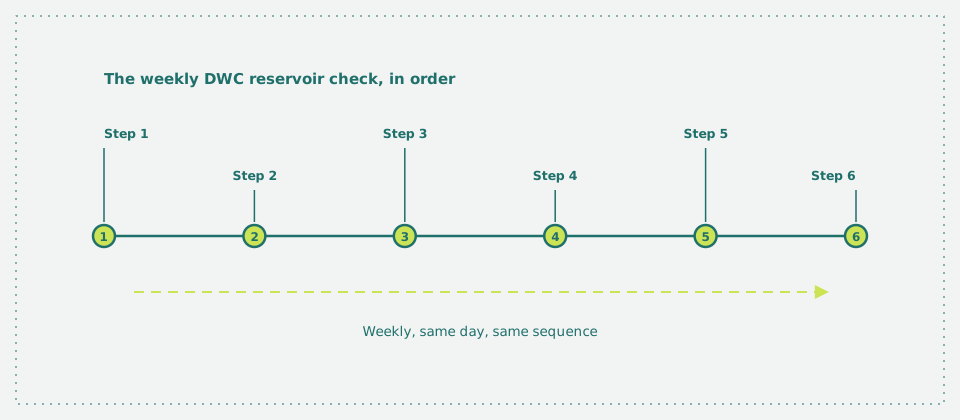
A weekly reservoir check takes four minutes and produces six numbers. Done in the wrong order it produces numbers that describe the water you just poured in rather than the water the plant has been living in for a week. The sequence is the whole method.
- Step 1Measure and write down the water level before touching anything elseThe drop since last week is the single best indicator of plant health and of whether an airstone is failing
- Step 2Measure EC and pH in that order, before topping upMeasuring after a top-up tells you about the water you just added, not about what the plant has been sitting in
- Step 3Top up to the mark with full-strength nutrient, then re-measure ECThe second reading is what the plant will actually experience for the next week
- Step 4Lift one net pot and inspect roots: colour, smell, slimeWhite and firm is healthy; brown and slick means the airstone or the temperature has been wrong for at least a week
- Step 5Pull the airstones, scrub them under hot water, and check the pump outlet flow by feelA scaled stone still bubbles visibly from above while the bottom of the reservoir has gone anoxic
- Step 6Record everything in one line: date, level, EC, pH, root noteThree weeks of one-line records will show a trend that a single reading can never reveal
Measure before you top up, always
The most common mistake in reservoir management is topping up first and then measuring. The reading you get afterwards describes a mixture of old solution and new, and it cannot tell you whether the plant consumed more water than nutrient or more nutrient than water over the previous week. Measuring beforehand gives you the actual state, and the difference between that reading and last week's tells you which way the plant is pulling.
The level drop is a diagnostic
Water loss between checks is driven by transpiration, which is driven by light, temperature and leaf area. A level that suddenly drops 40 % faster than last week means the canopy grew, the room got warmer, or there is a leak. A level that stops dropping means the plant has stopped transpiring, which is usually the first sign of a root problem that is not yet visible above the lid.
Root inspection is not optional
Lifting one net pot once a week is the only direct look you get at the half of the plant that lives in the dark. Healthy roots are white, firm and smell faintly of damp earth. Roots that are brown, translucent or slick are already in trouble, and the smell — sour, like a damp cellar — will tell you before the colour does. Catching it at this point means a reservoir change and a stone cleaning; catching it two weeks later means losing the crop.
One line per week beats any app
A single line per check, on paper or in a note, gives you a trend within a month. The value is not in any individual reading but in the shape: an EC that has fallen steadily for three weeks in a crop that should be at peak demand, or a pH that has climbed 0.3 every week regardless of what you add, are both patterns that a single measurement cannot show and that both point to a specific fix.
Key points
- Always measure level, EC and pH before topping up, never after
- A sudden change in the rate of water loss is a symptom, not noise
- Lift one net pot weekly; smell the roots as well as looking at them
- Scrub airstones every week rather than every month
- Keep one written line per week; the trend is the useful part
Sources
- Virginia Tech — https://www.hort.vt.edu/ghvegetables/documents/Hydroponics/Nutrient%20Film%20Technique%20Lettuce_LMorgan.pdf
- University of Padova — https://thesis.unipd.it/retrieve/cf7c45ea-4318-4977-aeeb-b05a8217ce63/Flaim_Gabriel.pdf
- Korean Journal of Horticultural Science — https://koreascience.kr/article/JAKO199911922406644.do
- University of Illinois Extension — https://extension.illinois.edu/sites/default/files/illinois_extension_hydroponics_handouts.pdf
Please noteThe figures referenced are general home-system references. Follow your nutrient label for mixing and dosing. This article is informational and is not professional horticultural advice.
- DWC Basil Tote: 20 L, six plants, and a pump that quietly decides everything · Build manual · 20 Aug 2026
- Kratky Top-Off Calendar: what to do on days 1, 14, 24 and 35 · Maintenance calendar · 17 Aug 2026
- NFT Flow Check: five things to verify every three days · Maintenance calendar · 22 Sept 2026