Maintenance calendar · Planning
Dutch Bucket Rotation: resetting the row between crops in one afternoon
A Dutch bucket row can be replanted the same week a crop finishes, but only if the reset is done properly. Perlite carries root fragments, elbows carry biofilm, and the drip stakes carry salts, and any of the three will shorten the next crop before it has even grown a leaf.
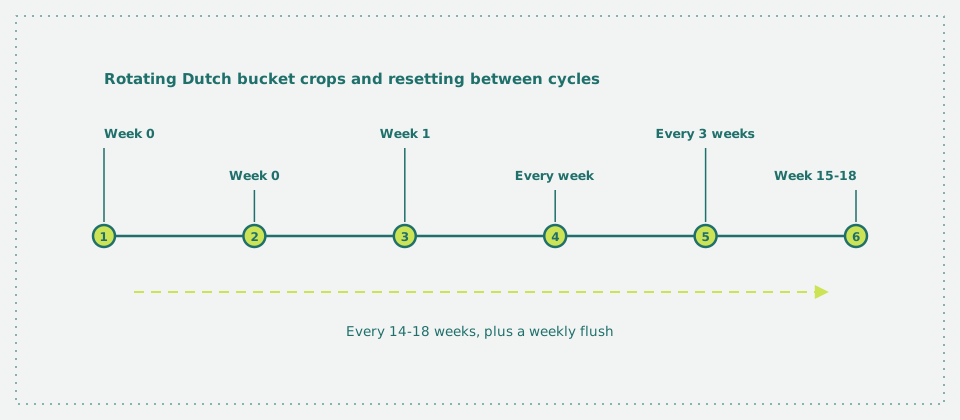
- Week 0Sterilise buckets, elbows and drip stakes with a 1 % hydrogen peroxide soak for 20 minutesPerlite holds root fragments in the perched water table, and those fragments carry any pathogen from the previous crop
- Week 0Replace the perlite if the previous crop ran longer than a full seasonPerlite breaks down and compacts over 4-5 months; compacted medium holds more water and less air at the bottom
- Week 1Plant the new crop and hold 1.4-1.5 mS/cm for the first two weeksBoth tomatoes and peppers take about two weeks to root into fresh medium and hate being pushed in that window
- Every weekRun one plain pH 6.0 water cycle and let it drain away rather than recirculatingSalt accumulates in a band just above the perched water table where the feeder roots are
- Every 3 weeksDump and fully recharge the reservoirUnabsorbed sodium and sulfate accumulate to the point where EC readings stop describing the root zone
- Week 15-18Final flush, harvest, then pull plants within three days of the last pickOld root systems continue to shed organic matter into the reservoir and degrade water quality for nothing
Perlite is reusable for one more cycle, not forever
Fresh perlite has sharp irregular surfaces with a lot of pore space between the grains. After four or five months of a fruiting crop, root hairs and fine organic matter fill that pore space and the medium holds more water and less air, particularly in the saturated band at the bottom of the bucket where it matters most. Replacing the medium every second crop costs very little and removes an entire class of late-season root problems.
Biofilm in the drain elbow is invisible and consequential
The 25 mm drain elbow sits in a permanently wet, dark, nutrient-rich environment, which is exactly what a biofilm needs. A visible brown film on the inside of the elbow is normal; leaving it there between crops means starting the next one with a bacterial population already established in the one part of the system you cannot easily inspect later. A 20-minute soak in 1 % hydrogen peroxide strips it out entirely.
The weekly flush is what makes three-weekly changes work
Running plain pH 6.0 water through the bucket once a week and letting it run to waste removes the salt band above the perched water table. Without it, those salts concentrate continuously and a reservoir reading of 2.2 mS/cm can coexist with a root-zone EC of 3.5 or more. With it, a full reservoir change every three weeks is enough to keep the system stable.
Pull old plants promptly
It is tempting to leave a finished plant in place for a few days while deciding what comes next. An old root system continues to shed organic matter and consume oxygen, and the water it leaves behind is measurably worse for it. Pulling within three days of the last harvest and starting the sterilisation immediately costs nothing and removes a week of unnecessary biofilm growth.
Key points
- Sterilise buckets, elbows and stakes with 1 % hydrogen peroxide between crops
- Replace perlite every second crop, not every crop
- Run one plain-water flush weekly; it is what makes 3-weekly changes sufficient
- Pull finished plants within three days of the last harvest
- Hold 1.4-1.5 mS/cm for the first two weeks of any new Dutch bucket crop
Sources
- Virginia Tech — https://www.hort.vt.edu/ghvegetables/documents/Hydroponics/Nutrient%20Film%20Technique%20Lettuce_LMorgan.pdf
- University of Padova — https://thesis.unipd.it/retrieve/cf7c45ea-4318-4977-aeeb-b05a8217ce63/Flaim_Gabriel.pdf
- Korean Journal of Horticultural Science — https://koreascience.kr/article/JAKO199911922406644.do
- University of Florida IFAS — https://edis.ifas.ufl.edu/publication/HS405
Please noteThe intervals and concentrations here are general references for home recirculating systems. Follow your nutrient label for mixing. This article is informational and is not professional horticultural advice.
- Dutch Bucket Tomatoes: two indeterminate plants, 60 L of reservoir, 17 weeks of harvest · Build manual · 5 Sept 2026
- Kratky Top-Off Calendar: what to do on days 1, 14, 24 and 35 · Maintenance calendar · 17 Aug 2026
- The DWC Weekly Log: six steps in the only order that gives you usable data · Maintenance calendar · 1 Sept 2026
- NFT Flow Check: five things to verify every three days · Maintenance calendar · 22 Sept 2026