Nutrient chart · Fruiting crops
Tomato and Cucumber in One Reservoir: where the two crops actually conflict
Sharing one reservoir between tomatoes and cucumbers is common at home and entirely workable, but only if you know which crop sets the limits. The two agree on pH almost exactly and disagree mildly on ratio, which makes the compromise easy to define.
| Stage | EC | pH | N-P-K | Notes |
|---|---|---|---|---|
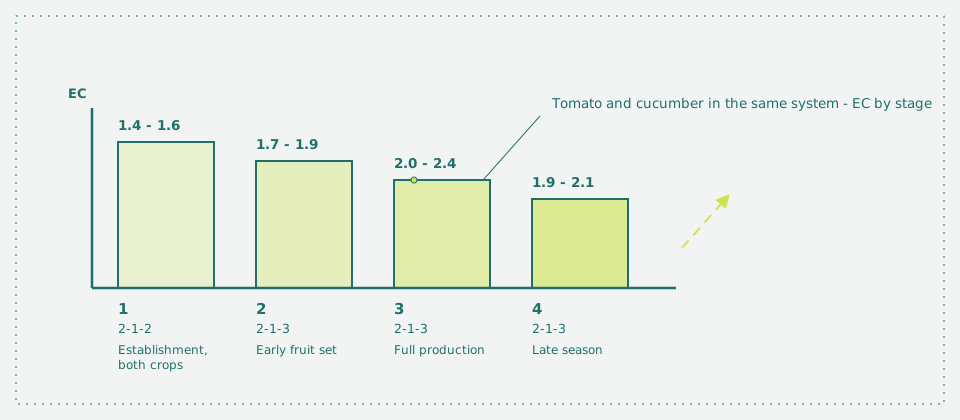
| Establishment, both crops | 1.4 - 1.6 | 5.9 - 6.1 | 2-1-2 | They agree completely here; no conflict in a shared reservoir |
| Early fruit set | 1.7 - 1.9 | 5.9 - 6.1 | 2-1-3 | Cucumber wants slightly more nitrogen, tomato slightly more potassium |
| Full production | 2.0 - 2.4 | 6.0 - 6.2 | 2-1-3 | The compromise: cucumber is the limiting crop above 2.4 |
| Late season | 1.9 - 2.1 | 6.0 - 6.2 | 2-1-3 | Ease back for both; neither ripens well when pushed at the end |
They agree on pH, which is the good news
Both crops want 5.8-6.2, with tomatoes marginally happier at the top of that band and cucumbers marginally happier at the bottom. In practice any value in the range works for both, and this is the single biggest reason a shared reservoir is practical at all. If you were trying to combine, say, blueberries at pH 4.5 with tomatoes at 6.0, no compromise would exist.
Cucumber is the ceiling, tomato is the floor
Cucumbers in a shared system start producing pale, misshapen fruit above about 2.4 mS/cm, which puts a hard ceiling on how hard you can push. Tomatoes would happily go to 2.6 or higher. Conversely, tomatoes held below 1.7 during fruiting produce watery, low-flavour fruit, while cucumbers are perfectly content there. Running the pair at 2.0-2.4 keeps both in their useful range.
Nitrogen timing differs more than ratio
The real difference between the two crops is not the target ratio but when they want it. A cucumber vine that is cropping needs steady nitrogen throughout, because it is growing new vine and new fruit simultaneously for months. A tomato at the same stage is mostly filling existing fruit. That means a shared reservoir should be topped up at full strength consistently rather than allowed to drift down, which favours the cucumber without hurting the tomato.
Cap the cucumber at 2.4 and the tomato follows
The practical rule for a mixed reservoir is to set the mix as if you were growing only cucumbers, and to compensate for the tomato's higher potassium appetite by choosing a vegetative-leaning tomato variety that fruits early. A cherry tomato handles 2.2 mS/cm perfectly well and ripens reliably, while a large beefsteak under the same regime tends to produce fruit that colours unevenly.
Key points
- Both crops are happy between pH 5.8 and 6.2; no conflict there
- 2.0-2.4 mS/cm is the shared window; cucumber sets the ceiling
- Above 2.4 mS/cm cucumbers produce pale, misshapen fruit
- Top up at full strength consistently rather than letting EC drift down
- In a shared system prefer a cherry tomato over a large beefsteak
Sources
- Korean Journal of Horticultural Science — https://koreascience.kr/article/JAKO199911922406644.do
- University of Padova — https://thesis.unipd.it/retrieve/cf7c45ea-4318-4977-aeeb-b05a8217ce63/Flaim_Gabriel.pdf
- University of Arizona CEAC — https://ceac.arizona.edu/sites/default/files/Chapter%2010.pdf
Please noteThese EC, pH and ratio figures are general references for home systems and vary with cultivar, climate and nutrient brand. Follow your product label. This article is informational and is not professional horticultural advice.
- Fruiting Crop EC and pH Chart by Stage: tomato, pepper, cucumber · Nutrient chart · 10 Sept 2026
- Dutch Bucket Tomatoes: two indeterminate plants, 60 L of reservoir, 17 weeks of harvest · Build manual · 5 Sept 2026
- Leafy Green EC and pH Chart by Stage: lettuce, mizuna, tatsoi, pak choi · Nutrient chart · 14 Aug 2026
- Soft Herb EC and pH Chart by Stage: basil, mint, parsley, coriander, dill · Nutrient chart · 24 Aug 2026