Maintenance calendar · Passive systems
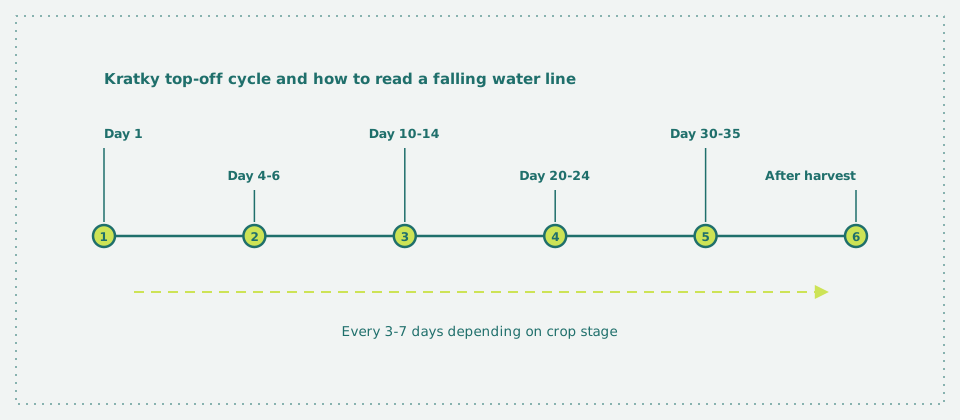
Kratky Top-Off Calendar: what to do on days 1, 14, 24 and 35
A passive bucket looks after itself, which is exactly why it goes wrong silently. There are only four moments in a five-week cycle where you have to do anything, and three of them are top-ups. This is what to do at each, and why the rest of the time doing nothing is the correct action.
- Day 1Charge to the marked fill line and record the EC, pH and the date on a strip of tape on the bucketOn a passive system the tape label is the only record you will have; without it you cannot tell drift from a bad mix
- Day 4-6Confirm roots have reached the solution; lift one net pot and lookIf roots have not reached water by day 6 in warm weather the seedlings will stall permanently
- Day 10-14First top-up once the level falls 3 cm; use plain water at pH 6.0The plants have taken up the salts they need; adding more nutrient here is what causes tipburn
- Day 20-24Second top-up, again plain water, and re-check pH afterwardspH climbs as anions are removed faster than cations; 0.3-0.5 of upward drift between top-ups is normal
- Day 30-35Harvest or recharge; do not attempt a third top-up on a 12 L bucketBelow about 40 % of the original volume the concentration swings become too large to manage
- After harvestRinse the bucket, scrub the water line, and start a fresh charge rather than reusing the old solutionRoot exudates and biofilm on the bucket wall carry over into the next crop
The tape label is the whole management system
On an active system you can read the reservoir at any moment. On a Kratky bucket the only data you have is what you wrote down on day one and what the level looks like now. Writing the charge date, EC and pH on a strip of tape costs ten seconds and tells you, three weeks later, whether the plant is drinking faster or slower than it should be. Without it, a bucket that has drifted from 1.2 to 0.7 is indistinguishable from one that was mixed at 0.7.
Plain water is correct for the first two top-ups
The instinct to add nutrient at every top-up is the most common way a Kratky crop fails. In the first three weeks the plant takes up water and salts at roughly the rate they were supplied, so replacing the lost volume with plain water restores the concentration the plant is used to. Adding full-strength solution to a 12 L bucket at day 14 can push the effective EC from 1.2 to 1.6, and the plant's response is burnt leaf margins a week later.
Never let it fall past the halfway mark
Below roughly 40 % of the original volume there is not enough liquid to buffer a day's transpiration, and the concentration swings become large enough to matter. Two top-ups over thirty-five days is the design; a bucket that has needed a third top-up by day 25 was too small for the crop it is carrying, and the fix is a larger reservoir next cycle, not more frequent attention.
The end of the cycle is a reset, not a refill
When the crop is finished, the correct action is to empty, scrub and start again. Reusing the remaining solution carries over root exudates, biofilm and any pathogen that established in the last week. A five-minute scrub with hot water and a fresh charge is faster and more reliable than any attempt to rebalance what is left in the bucket.
Key points
- Write the charge date, EC and pH on tape on day one
- Top up with plain water at pH 6.0 for the first two top-ups
- Do not add nutrient between day 1 and harvest
- Stop topping up once the level falls below about 40 % of the original
- Empty, scrub and recharge between crops rather than reusing the solution
Sources
- Virginia Tech — https://www.hort.vt.edu/ghvegetables/documents/Hydroponics/Nutrient%20Film%20Technique%20Lettuce_LMorgan.pdf
- University of Padova — https://thesis.unipd.it/retrieve/cf7c45ea-4318-4977-aeeb-b05a8217ce63/Flaim_Gabriel.pdf
- Korean Journal of Horticultural Science — https://koreascience.kr/article/JAKO199911922406644.do
- Cornell Cooperative Extension — https://dlc.cce.cornell.edu/pluginfile.php/344771/mod_page/content/4/Neumann%20-%20Master%20Project%20-%20Kratky%20Hydroponic%20Gardening.pdf
Please noteThe intervals and volumes here are general references for home passive systems and vary with crop, climate and reservoir size. Follow your nutrient label for mixing. This article is informational and is not professional horticultural advice.
- Kratky Lettuce Bucket: a 12 L no-pump system that runs 35 days on one charge · Build manual · 11 Aug 2026
- Kratky Herb Jars: three 1 L windowsill jars that beat a supermarket pot by week six · Build manual · 15 Sept 2026
- The DWC Weekly Log: six steps in the only order that gives you usable data · Maintenance calendar · 1 Sept 2026
- NFT Flow Check: five things to verify every three days · Maintenance calendar · 22 Sept 2026