Build manual · Kratky still water · Leafy greens
Kratky Lettuce Bucket: a 12 L no-pump system that runs 35 days on one charge
The Kratky method grows lettuce in a bucket with no pump, no air stone and no electricity beyond a light. You charge the reservoir once, set the pots, and let the water level fall. This build covers the exact 12 L configuration, the four points where beginners fail, and what the nutrient curve actually does over five weeks.
- Reservoir
- 12 Lworking volume
- Planting sites
- 4sites
- Pump
- nonepassive
- Air stones
- 0not required
- EC target
- 1.2 mS/cmtarget
- pH window
- 5.8 - 6.2pH
- Light at canopy
- 220 PPFDat leaf
- Photoperiod
- 14 hper day
- Cycle length
- 35 daysplant to harvest
Top-up routine — Top up with plain pH-adjusted water whenever the level drops 3 cm below the net pot bases, usually day 12 and again around day 24.
| Part | Specification | Qty | Substitute |
|---|---|---|---|
| Food-grade HDPE bucket with lid | 12 L, opaque, 28 cm diameter | 1 | Any 10-15 L paint bucket works if you wrap it in black tape to block light |
| Net pots | 5 cm rim, 4 cm basket depth | 4 | Cut 50 mm holes in the lid and drop in 50 mm mesh pots |
| Clay pebbles (LECA) | 8-16 mm, rinsed until runoff runs clear | 2 L | Rockwool cubes plus a collar of perlite also hold the plug upright |
| Lettuce plugs | 3-week-old seedlings, 2 true leaves | 4 | Direct-sown LECA with 3 seeds per pot, thinned to one at day 10 |
| Two-part hydroponic nutrient | Part A calcium nitrate + Part B micronutrient blend | 250 mL each | Any lettuce-formula dry salt blend weighed to 1.2 mS/cm works the same |
| pH down | Phosphoric acid 45 %, food grade | 250 mL | Citric acid works but drifts upward within 36 hours |
| EC meter | 0.0-9.9 mS/cm, ±2 % accuracy, ATC | 1 | A cheap 0-1999 µS pen is fine, just calibrate it with 1.413 mS standard |
| LED bar | 4000 K white, 30 W draw, 60 cm | 1 | A 6500 K shop light raised to 30 cm gives a usable 200-260 PPFD |
Drill the lid before anything gets wet
Lay the lid upside down on scrap wood and cut four 50 mm holes on a 14 cm square grid. Keep at least 6 cm between hole edges and the rim, otherwise the lid flexes and cracks when you lift a full pot of wet pebbles.
Mix the starting charge to 1.2 mS/cm
Fill the bucket with 11 L of tap water, let it stand 2 hours so chlorine off-gasses, then stir in Part A until the meter reads 0.6, wait 5 minutes, and add Part B to reach 1.2. Never pre-mix A and B concentrate in the same cup; the calcium and sulfate will drop out as gypsum.
Set pH to 6.0 and stop chasing it
Add pH down 1 mL at a time, stirring for 30 seconds between additions. Lettuce tolerates 5.8-6.2, so land anywhere in that band and leave it. Below 5.2 the calcium uptake stalls and new leaves crinkle; above 7.0 iron locks out and the centres of the leaves go yellow.
Seat the pots so the water line sits right
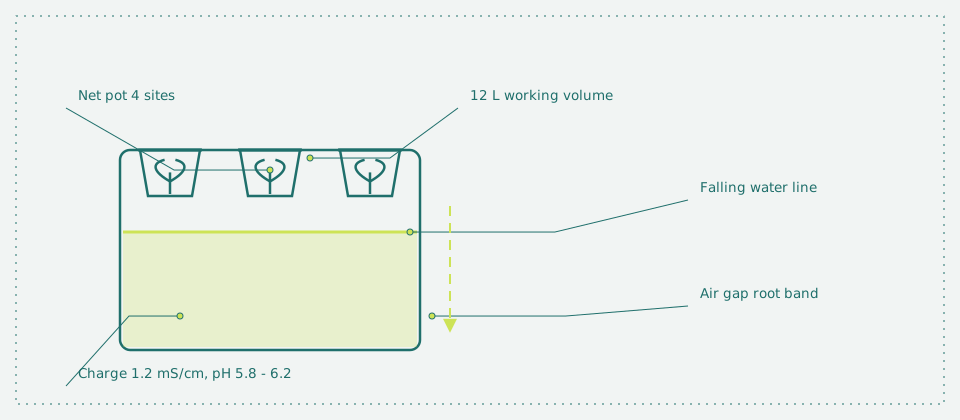
The liquid must touch the bottom 6-8 mm of each net pot at the start, then fall away as the plants drink. That falling gap is the whole Kratky mechanism: the top of the root mass stays in humid air and the tips keep drinking. If the water is still touching the pebbles at day 14, you filled it too high.
Hang the light 25 cm over the lid
Run 14 hours on, 10 hours off with a mechanical timer. At 25 cm a 30 W bar gives about 220 PPFD at leaf level, which is where lettuce stops stretching and starts heading. Closer than 15 cm and the leaf edges scorch chalky white within three days.
Top up, never re-charge
When the level falls 3 cm, replace the lost volume with plain water adjusted to pH 6.0. Do not add more nutrient between day 1 and harvest. The plants have already pulled the salts they need, and topping up concentration mid-cycle is the most common way a clean bucket turns into a tipburned mess.
Week 1
EC 1.2 · pH 6.0
- Check that roots reach water by day 4
- Keep light at 14 h
- Do nothing else; seedlings hate fiddling
Week 2
EC 1.2 · pH 6.0
- First top-up typically lands here
- Turn pots 180 degrees so the head grows even
Week 3
EC 1.2 falling · pH 6.1
- Expect the level to drop 1.5-2 cm per day
- Shift light up to 30 cm as plants widen
Week 4
EC 1.0 falling · pH 6.1
- Second top-up
- Watch for the first brown tipburn spots on outer leaves
Week 5
EC 0.9 · pH 6.2
- Harvest outer leaves or cut the whole head at 35-38 days
- Do not refill after cutting; start a fresh bucket
Why letting the water fall is the entire technique
In a Kratky bucket the initial water level touches the bottom of the net pots. As the plants transpire, the level drops and a band of roots is left hanging in saturated air. That band is where the oxygen comes from (per Cornell Cooperative Extension). Roots sitting permanently in still water suffocate and turn brown within a week, which is why simply keeping the bucket full is the fastest way to kill a Kratky crop. The design is self-correcting as long as you never refill past the original line.
The 12 L size is not arbitrary
A single butterhead lettuce drinks roughly 260-320 mL per day at week four under 220 PPFD. Four plants therefore draw about 1.2 L per day at peak, so a 12 L charge covers 35 days once you account for the 3 cm gap you must leave and the two top-ups. Drop to a 6 L bucket and you will be topping up every second day; go to a 20 L bucket and the plants sit in a reservoir tall enough that the water line never drops far enough to expose roots.
Nitrogen demand peaks in week three, not week one
Seedlings in the first ten days take up very little. The measurable draw starts when the head begins to fold in on itself, usually day 16-18, and it is at that point that a 1.2 mS/cm charge — at the low end of the 1.2–1.6 mS/cm optimum for lettuce (per Korean Journal of Horticultural Science) — starts dropping. By day 30 the same bucket often measures 0.9. That downward drift is correct behaviour, not a problem to fix. Catching it and adding nutrient is what produces the classic dark, brittle, tipburned leaf edges.
What actually goes wrong
Three failure modes account for almost every dead Kratky bucket. Algae blooms because the reservoir is translucent or the lid has an open gap, and the green film then competes for the same nitrogen the lettuce needs. Pythium root rot follows any period where the water sat above 24 C. And tipburn, the brown edge on inner leaves, is a calcium transport failure driven by heat and low airflow rather than a calcium shortage in the solution, so adding cal-mag rarely helps.
Key points
- Charge once to 1.2 mS/cm and pH 6.0; top up with plain water only
- Initial level touches the bottom 6-8 mm of the net pots, then falls
- A 12 L reservoir lasts a 4-plant lettuce crop the full 35 days
- Keep solution under 24 C or pythium will find it
- Tipburn is an airflow and heat problem, not a calcium shortage
Sources
- Cornell Cooperative Extension — https://dlc.cce.cornell.edu/pluginfile.php/344771/mod_page/content/4/Neumann%20-%20Master%20Project%20-%20Kratky%20Hydroponic%20Gardening.pdf
- University of Hawaii CTAHR — https://www.ctahr.hawaii.edu/Hawaii/downloads/A%20Non-circulating%20Hydroponic%20Kit%20for%20Leaf%20and%20Semi-Head%20Lettuce.pdf
- Korean Journal of Horticultural Science — https://koreascience.kr/article/JAKO199911922406644.do
Please noteEC and pH figures here are general starting points for home systems and vary with your water supply, nutrient brand and cultivar. Always follow the dosage on your product label. This article is informational and is not professional horticultural or food-safety advice.
- Kratky Herb Jars: three 1 L windowsill jars that beat a supermarket pot by week six · Build manual · 15 Sept 2026
- DWC Basil Tote: 20 L, six plants, and a pump that quietly decides everything · Build manual · 20 Aug 2026
- Leafy Green EC and pH Chart by Stage: lettuce, mizuna, tatsoi, pak choi · Nutrient chart · 14 Aug 2026
- NFT Lettuce Rail: two 1.8 m channels, 24 plants, 30 days from plug to plate · Build manual · 28 Aug 2026