Maintenance calendar · Environment
Winter Lighting Calendar: what to change each month from October to February
Every indoor hydroponic system loses light in winter and gains root-zone problems at the same time, and the two are handled differently. The monthly adjustments below keep a leafy crop producing through the darkest quarter without pushing anything into bolting when the light returns.
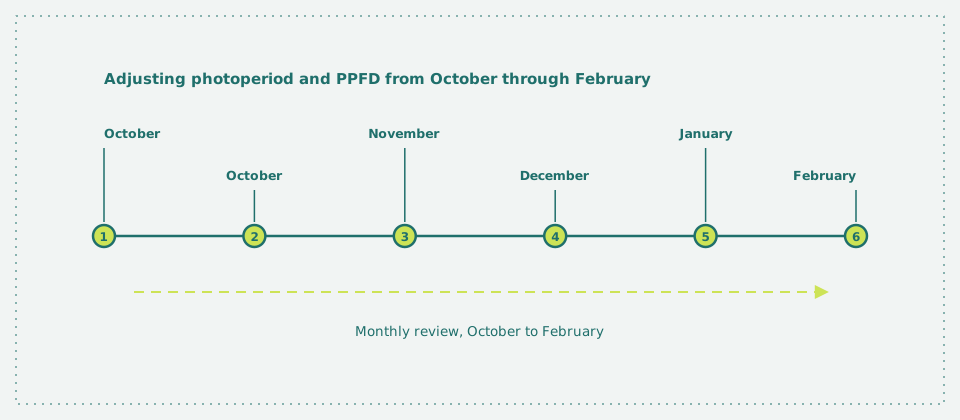
- OctoberMeasure the PPFD at canopy height with a phone app or a cheap quantum sensor and write it downA windowsill that gave 400 PPFD in July gives 60 in December; without a measurement the decline is invisible
- OctoberRaise the photoperiod on leafy crops from 14 to 15 hoursLeafy greens respond to total daily light rather than intensity, so extra hours are the cheapest correction
- NovemberLower the light fixture so the canopy still receives its target PPFDHalving the distance quadruples the intensity; this is usually enough to hold a leafy crop steady through December
- DecemberWatch root-zone temperature; cold solution slows uptake long before the leaves look unhappyBelow 16 C most crops stop taking up phosphate efficiently and growth stalls with no visible deficiency
- JanuaryDo not increase the EC to compensate for slow growthCold roots take up less water and less salt; raising the EC in a cold reservoir causes salt burn rather than growth
- FebruaryStart reducing the photoperiod back toward 14 hours and re-measure the windowsill lightNatural light returns quickly and the total daily light can overshoot, pushing leafy crops to bolt
October: buy a number before you buy another light
Here is what fools people in October. Human vision adapts to light so completely that a late-November windowsill still reads as "bright" to the eye while actually delivering a fraction of what the same sill gave in July. You cannot manage what you cannot see, so the first line of the winter budget is not a bigger fixture, it is a measurement. A cheap handheld quantum sensor is plenty; a phone light-meter app is better than nothing. The band to aim at for lettuce is 150-300 umol m-2 s-1, and above 300 you are paying real money for very little extra growth (Nature Scientific Reports). Same spot, canopy height, once a month, from October onwards. That single reading is what makes the rest of this calendar an adjustment instead of a guess.
November into December: buy hours, not watts
Leafy crops respond to daily light integral, the total photons delivered across a whole day, more than to how bright the fixture looks in any one second. Turn that around and it is good news, because a timer costs nothing and a light bar does not. Photoperiods of 12-16 hours are the common range for hydroponic lettuce (Nature Scientific Reports), so through late November there is room to walk 14 hours up to 15 or 16 without spending a cent. Mind the ceiling, though: in one indoor trial iceberg lettuce did best at a DLI of 11.5 mol m-2 d-1 and actually lost fresh weight at 14.4 (same paper). That is a polite way of saying the top of the familiar greenhouse 12-16 range is not automatically the sweet spot once you are pushing it under LEDs in a basement. Fruiting crops play a different game. Tomatoes, peppers and basil want genuine intensity, which is why University of Illinois Extension puts them at 70-80 F days and 60-70 F nights; for those, drop the fixture toward the canopy instead of stretching the day. And when you see 16-to-24-hour schedules recommended for grow lights generally (SARE), read it as a timer habit, not a lettuce recommendation. Twenty-four hours straight has never once outgrown 16 on our shelves.
January: the reservoir is where the winter really happens
Nobody warns you about the water. Room temperature falls, solution temperature follows, and water's thermal mass means it comes back up slowly. Somewhere below roughly 16 C, uptake of phosphate and several micronutrients falls off a cliff. The plant keeps its colour, looks fine for a while, and then quietly stops, with no yellowing and no other symptom to point at. Virginia Tech puts the ideal NFT solution temperature at 18-22 C, and SARE's 65-70 F (18-21 C) for cool-season greens like lettuce lands inside that same window, two sources pointing at one bullseye. A small aquarium heater set to about 19-20 C in the reservoir is the highest-value thing you can add to a winter system, and it draws far less power than the lamp overhead. Test the water temperature during the coldest week of January, not in mild October when everything still looks fine.
February: hands off the EC dial, and start giving hours back to the sun
Growth is still sluggish in early February and that is exactly when the hand drifts toward the EC knob. Resist it. Cold roots take up less water and less salt, so raising EC only concentrates a root zone that is already struggling, and you trade a slow crop for burned leaf margins and a stall that outlasts the problem you were trying to fix. If the EC was right in November it is still right in February; fix water temperature and photoperiod first. The other February job points the opposite direction. Outdoor light climbs week by week, so you can begin walking the artificial photoperiod back toward 12 hours, the low end of the lettuce range (Nature Scientific Reports), and let the window carry more of the load. If you are starting tomatoes or peppers for spring, remember they run warmer than the greens ever did, 70-80 F by day and 60-70 F at night (University of Illinois Extension), so they do not belong in the same tent as lettuce in February even if the two shared space happily back in October.
Key points
- Measure PPFD monthly; a December windowsill can be a sixth of its July value
- Add an hour of photoperiod rather than buying a stronger fixture for leafy crops
- Keep the root zone at 19-20 C with an aquarium heater from November
- Never raise the EC to compensate for cold-weather slowdown
- Reduce photoperiod again in February to avoid pushing crops into bolting
Sources
- Virginia Tech — https://www.hort.vt.edu/ghvegetables/documents/Hydroponics/Nutrient%20Film%20Technique%20Lettuce_LMorgan.pdf
- University of Padova — https://thesis.unipd.it/retrieve/cf7c45ea-4318-4977-aeeb-b05a8217ce63/Flaim_Gabriel.pdf
- Korean Journal of Horticultural Science — https://koreascience.kr/article/JAKO199911922406644.do
- Nature Scientific Reports — https://www.nature.com/articles/s41598-023-36997-2
Please noteLight, temperature and nutrient values are general references for home indoor systems and vary with crop and climate. This article is informational and is not professional horticultural advice.
- Kratky Lettuce Bucket: a 12 L no-pump system that runs 35 days on one charge · Build manual · 11 Aug 2026
- Kratky Top-Off Calendar: what to do on days 1, 14, 24 and 35 · Maintenance calendar · 17 Aug 2026
- The DWC Weekly Log: six steps in the only order that gives you usable data · Maintenance calendar · 1 Sept 2026
- NFT Flow Check: five things to verify every three days · Maintenance calendar · 22 Sept 2026