Build manual · Kratky still water · Leafy greens
Kratky Swiss Chard: two plants, one recharge, three months of cutting
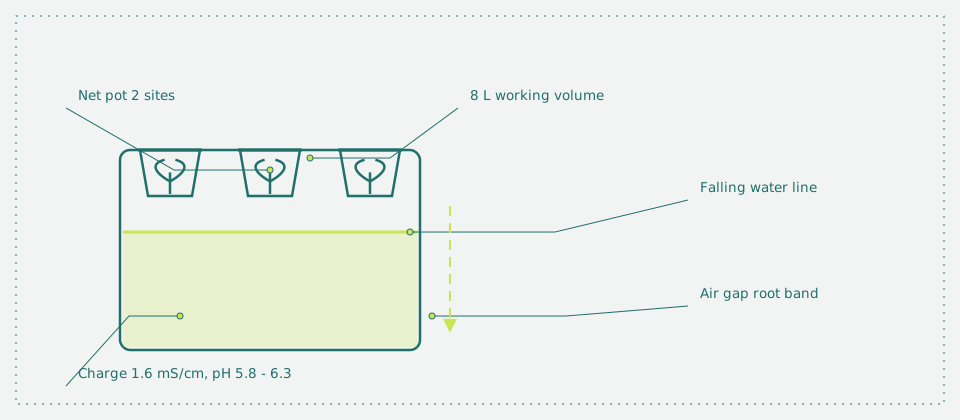
Chard is the best long-cycle crop for a passive bucket. It tolerates a higher nutrient strength than lettuce, regrows from the centre for months, and unlike most leafy greens it does not bolt the moment temperatures wobble. The only change to standard Kratky is one mid-cycle recharge.
- Reservoir
- 8 Lworking volume
- Planting sites
- 2sites
- Pump
- nonepassive
- Air stones
- 0not required
- EC target
- 1.6 mS/cmtarget
- pH window
- 5.8 - 6.3pH
- Light at canopy
- 260 PPFDat leaf
- Photoperiod
- 14 hper day
- Cycle length
- 90 daysplant to harvest
Top-up routine — Chard is a cut-and-come-again crop on a long cycle; top up 400 mL of plain pH 6.0 water every 6-8 days and re-charge the bucket once at day 45.
| Part | Specification | Qty | Substitute |
|---|---|---|---|
| Opaque bucket with lid | 8 L, 24 cm diameter | 1 | A 5 L food container works for one plant; two chard need the extra root volume |
| Net pots | 75 mm rim | 2 | 50 mm pots are enough at planting but the stem base thickens by week 8 |
| LECA | 8-16 mm | 1.5 L | A 50/50 LECA and perlite mix holds slightly more air around the crown |
| Chard seed | Fordhook Giant or Bright Lights, 3 seeds per pot | 6 seeds | Transplant a 3-week seedling instead to save ten days |
| Two-part nutrient | Leafy formula, 1.6 mS/cm | 250 mL each | Chard tolerates a general-purpose tomato feed at 1.6 without problems |
| pH down | Phosphoric acid 45 % | 250 mL | Chard on hard water will need more acid than lettuce on the same supply |
| LED bar | 40 W, 4000 K, 60 cm | 1 | A bright south window at 10 cm delivers roughly 260 PPFD for four hours in winter |
Sow three seeds per pot and thin hard at day 12
Chard seed is actually a corky cluster of two or three true seeds, so a single 'seed' often gives three seedlings. Thin to one plant per net pot at day 12 by cutting the extras at the base rather than pulling, which would disturb the root of the one you keep.
Charge at 1.6 mS/cm, higher than lettuce
Chard is a heavier feeder than lettuce and holds up well at 1.6 mS/cm from the start. On the same 1.2 charge that suits lettuce, chard grows slowly and the leaves stay small and dark. Because the cycle runs 90 days, this higher charge is also what makes the long intervals between recharges work.
Harvest outer leaves from week 6, never the crown
Cut the outermost 3-4 leaves at the base when they reach 20 cm, leaving at least six leaves on the plant. Chard regrows from the centre, so a plant that keeps its core will produce for three months. Cutting the whole head at once ends the cycle at harvest number one.
Recharge the bucket once, at day 45
Kratky works on a falling water line, but on a 90-day crop the solution is exhausted well before the plant is. At around day 45, when the level is 4 cm down, top up to the original mark with fresh 1.6 mS/cm solution rather than plain water. This single mid-cycle recharge roughly doubles total leaf yield without changing anything else.
Keep the light at 14 hours year round
Chard is day-length sensitive enough that winter light levels push it into slow, thin growth. A 14 hour photoperiod at 260 PPFD keeps it producing through December, when a windowsill alone would give it perhaps four usable hours of the intensity it needs.
Watch for leaf miner, not deficiencies
The main pest on indoor chard is leaf miner, which shows as pale blotches between the leaf veins. Pick and destroy affected leaves immediately rather than trying to treat the plant; on a two-plant bucket, removing four leaves is cheaper than any intervention, and the plant replaces them in ten days.
Week 1-3
EC 1.6 · pH 6.0
- Thin to one plant per pot at day 12
- Keep light 14 h
- Check roots reach water by day 5
Week 4-6
EC 1.6 · pH 6.1
- First top-up around day 40
- Begin harvesting outer leaves at 20 cm
Week 7-9
EC 1.6 recharged · pH 6.0
- Recharge to full mark with fresh solution at day 45
- Harvest 2-3 leaves per plant per week
Week 10-13
EC 1.3 falling · pH 6.1
- Continue cutting outer leaves
- Remove any leaf with miner blotches
- Expect a slowdown after day 80
A 90-day crop breaks the standard Kratky rule
The classic Kratky method assumes you charge once and never add nutrient, which works on a 35-day lettuce cycle. Chard runs 90 days on the same bucket, and by day 45 the solution has given up most of its nitrogen and the plant is visibly slowing. One recharge to the original mark with fresh 1.6 mS/cm solution at day 45 keeps the falling water line while restoring the salt balance.
Cut outer leaves and the plant lasts three months
Chard grows new leaves from the centre of the crown continuously. Taking the outermost leaves at 20 cm, three or four at a time and never more than half the plant, keeps the core intact and the harvest going. Cutting the whole plant at once is faster and ends the cycle immediately, since there is no core left to regrow from.
Hard water is the hidden variable
Chard pulls calcium and magnesium heavily and on a hard-water supply the pH in an 8 L bucket will climb from 6.0 toward 6.8 within a week of each top-up, because the plant removes anions faster than cations. Checking pH after every top-up and adjusting back to 6.0 is more important on chard than on any other crop in a small passive bucket.
The leaves get tougher, not bigger, past day 80
From about week 11 the plant is running on a root system that is older than the leaves it is supporting, and the petioles get fibrous while leaf size stays flat. There is no intervention that reverses it. Plan to start replacement seedlings at day 70 so a fresh bucket is ready before the old one stops earning its space.
Key points
- 1.6 mS/cm start, higher than lettuce, because chard is a heavy feeder
- Recharge to the full mark with fresh solution at day 45
- Harvest only outer leaves at 20 cm; never cut the crown
- Check pH after every top-up; hard water pushes it up fast
- Start replacement seedlings at day 70 so the next bucket takes over without a gap
Sources
- Cornell Cooperative Extension — https://dlc.cce.cornell.edu/pluginfile.php/344771/mod_page/content/4/Neumann%20-%20Master%20Project%20-%20Kratky%20Hydroponic%20Gardening.pdf
- University of Hawaii CTAHR — https://www.ctahr.hawaii.edu/Hawaii/downloads/A%20Non-circulating%20Hydroponic%20Kit%20for%20Leaf%20and%20Semi-Head%20Lettuce.pdf
- Korean Journal of Horticultural Science — https://koreascience.kr/article/JAKO199911922406644.do
Please noteEC, pH and light figures are general home-system references and will vary with your water supply and nutrient brand. Follow the product label. This article is informational and is not professional horticultural advice.
- Kratky Lettuce Bucket: a 12 L no-pump system that runs 35 days on one charge · Build manual · 11 Aug 2026
- Kratky Herb Jars: three 1 L windowsill jars that beat a supermarket pot by week six · Build manual · 15 Sept 2026
- Leafy Green EC and pH Chart by Stage: lettuce, mizuna, tatsoi, pak choi · Nutrient chart · 14 Aug 2026
- DWC Basil Tote: 20 L, six plants, and a pump that quietly decides everything · Build manual · 20 Aug 2026