Build manual · Kratky still water · Microgreens
Kratky Microgreen Tray: sunflower and radish in 12 days on 8 mm of solution
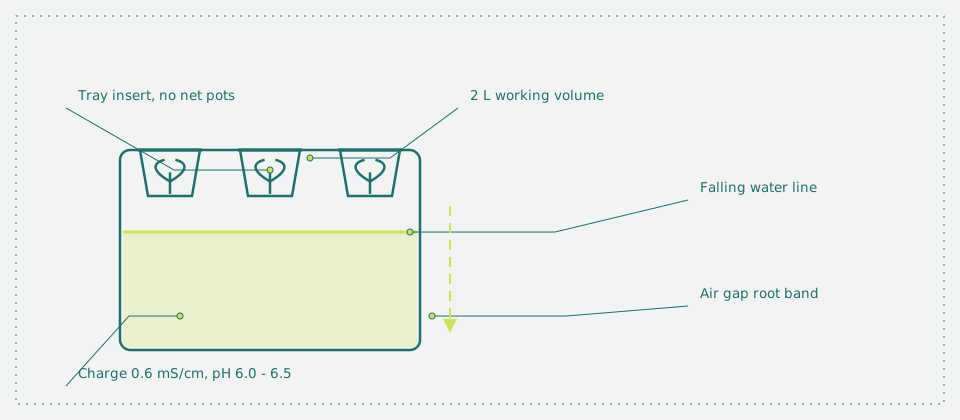
Microgreens are the fastest thing you can grow hydroponically and the easiest to ruin with kindness. The whole cycle is twelve days, the reservoir is 8 mm deep, and almost every failure comes from too much water, too much heat during blackout, or too much light at the end.
- Reservoir
- 2 Lworking volume
- Planting sites
- 0sites
- Pump
- nonepassive
- Air stones
- 0not required
- EC target
- 0.6 mS/cmtarget
- pH window
- 6.0 - 6.5pH
- Light at canopy
- 200 PPFDat leaf
- Photoperiod
- 12 hper day
- Cycle length
- 12 daysplant to harvest
Top-up routine — Keep 8 mm of solution in the lower tray; check every morning and add 100-150 mL of 0.6 mS/cm solution when the mat is no longer touching liquid.
| Part | Specification | Qty | Substitute |
|---|---|---|---|
| Two trays | 25 x 40 cm, one with drainage slots nested inside one solid | 2 | A standard 10 x 20 nursery flat inside a solid bakery tray |
| Growing mat | Hemp or jute fibre, 8 mm thick, cut to tray size | 1 | Unbleached paper towel at 4 layers works once but tears when harvested |
| Microgreen seed | Sunflower, radish or pea, untreated | 35 g | Broccoli and kale seed at 12 g per tray gives a slower but denser canopy |
| Weight for blackout | Second tray filled with 2 kg of dry sand | 1 | Any flat board with a couple of books; the goal is firm seed-to-mat contact |
| Single-part nutrient | General purpose, diluted to 0.6 mS/cm | 100 mL | Microgreens live on seed reserves; plain tap water works for a 12-day cycle if your water is under 0.3 mS/cm |
| Spray bottle | 1 L, fine mist | 1 | A watering can with a rose head is too coarse and dislodges the seed |
| LED bar | 20 W, 4000 K, 60 cm | 1 | A bright east window for the last four days is often enough in summer |
Soak the mat, then drain it flat
Submerge the fibre mat for two minutes and let it drip until it stops. The mat should be damp, not dripping into the lower tray. A mat that is still releasing water will keep the seed wet for 48 hours and that is where damping-off starts.
Sow dense, then press
Spread 35 g of sunflower seed so the mat is covered with almost no gaps, then press with the weighted tray for 12 hours. Seed-to-mat contact is the single factor that decides whether the roots anchor; seed that stays loose washes into a corner in the first watering and never recovers.
Blackout for four days, at 20-22 C
Keep the weighted tray on and put the whole stack somewhere dark at 20-22 C. In four days you should see 4-5 cm of pale stem. Warmer than 24 C and the stems stretch thin and fall over at harvest; cooler than 18 C and germination takes seven days and the mat may mould.
Reveal the tray and drop the water to 8 mm
Uncover on day 4 and pour 8 mm of 0.6 mS/cm solution into the lower tray, letting the mat wick it up. From here the requirement is simple: the mat never dries and the seed heads never sit in liquid. Anything more than 8 mm and the stems rot at the base within a day.
Run 12 hours of light for six days
Twelve hours on, twelve off for the final six days is enough for full colour and flavour development on radish and broccoli. More light does not make them bigger; it makes them tougher and pushes flowering. Sunflower at 200 PPFD finishes at 10-12 cm in this window.
Harvest with scissors, above the mat
Cut 5-8 mm above the fibre mat in one pass, holding the canopy with your other hand. Do not wash the cut greens; water drives the shelf life from eight days down to three. Refrigerate in a paper-lined box and eat within a week.
Day 0
EC - · pH -
- Soak mat, sow 35 g, press 12 h
Day 1-4
EC - · pH -
- Blackout under the weighted tray at 20-22 C
- Do not water; the mat holds enough
Day 4
EC 0.6 · pH 6.2
- Uncover, add 8 mm of solution to the lower tray
- Start 12 h light cycle
Day 5-9
EC 0.6 · pH 6.2
- Top up 100-150 mL when the mat stops touching liquid
- Turn the tray a quarter turn daily
Day 10-12
EC 0.6 · pH 6.3
- Harvest in one pass, 5-8 mm above the mat
- Do not rinse; refrigerate dry
The seed does the work, not the nutrient
A sunflower seed carries enough stored energy to produce a 10 cm stem with no external nutrition at all. That is why a 0.6 mS/cm solution — barely above most tap water — is enough for a twelve-day cycle. Pushing to 1.5 in the belief that more food means faster growth produces tip burn on the cotyledons and a noticeable bitterness.
Eight millimetres is the whole water budget
Wicking mats move water by capillary action, so the moisture front rises from the lower tray into the mat. Eight millimetres keeps the mat damp to the surface without the standing layer reaching the seed. At 15 mm the stems sit in liquid, oxygen disappears from the base and damping-off takes the tray within 24 hours. At 3 mm the mat dries at the edges and those seedlings stop growing.
Blackout temperature decides stem quality
The four days under the weighted tray are etiolation, not growth: the seedling stretches to reach light it cannot find. At 20-22 C it produces a sturdy 4-5 cm stem. At 26 C the same seed produces 8 cm of thin, pale tissue that collapses the moment it is uncovered. This is the single most common reason home trays come out floppy.
Twelve days is a hard deadline
After about day 12 the cotyledons have exhausted the seed reserve and the plant either needs real nutrition or starts to decline. Leaving a tray to day 16 in the hope of a bigger harvest gives yellowing leaves, a tougher stem and the first true leaves pushing through, which changes both flavour and texture. Sow a new tray every four days instead of stretching an old one.
Key points
- 0.6 mS/cm is enough; the seed supplies the rest
- 8 mm in the lower tray, no more, or the stems rot
- Blackout at 20-22 C for 4 days for sturdy stems
- Press the seed for 12 hours so the roots anchor to the mat
- Never rinse harvested greens; it costs five days of shelf life
Sources
- Cornell Cooperative Extension — https://dlc.cce.cornell.edu/pluginfile.php/344771/mod_page/content/4/Neumann%20-%20Master%20Project%20-%20Kratky%20Hydroponic%20Gardening.pdf
- University of Hawaii CTAHR — https://www.ctahr.hawaii.edu/Hawaii/downloads/A%20Non-circulating%20Hydroponic%20Kit%20for%20Leaf%20and%20Semi-Head%20Lettuce.pdf
- Korean Journal of Horticultural Science — https://koreascience.kr/article/JAKO199911922406644.do
Please noteNutrient strengths and temperature windows are general references for home microgreen production. Follow any seed supplier's food-safety guidance. This article is informational and is not professional food-safety or horticultural advice.
- Kratky Lettuce Bucket: a 12 L no-pump system that runs 35 days on one charge · Build manual · 11 Aug 2026
- Kratky Herb Jars: three 1 L windowsill jars that beat a supermarket pot by week six · Build manual · 15 Sept 2026
- DWC Basil Tote: 20 L, six plants, and a pump that quietly decides everything · Build manual · 20 Aug 2026
- NFT Lettuce Rail: two 1.8 m channels, 24 plants, 30 days from plug to plate · Build manual · 28 Aug 2026