Maintenance calendar · Maintenance
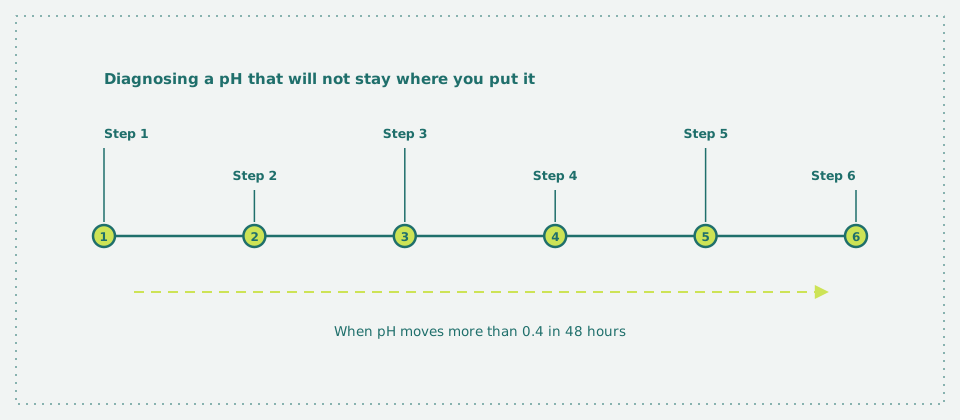
pH Drift Audit: six steps to run before you add anything to the reservoir
A pH that will not stay put is the most common complaint in home hydroponics and the one most often treated with the wrong action. In the majority of cases the reading is wrong, the drift is normal, or the cause is biological — and adding acid makes two of those three worse.
- Step 1Re-calibrate the pH pen with fresh 4.01 and 7.00 buffer solutionsA pen that has drifted 0.3 reads every reservoir as wrong, and this is the most common cause of a pH panic
- Step 2Measure the starting EC and pH of your plain tap water and write both downHard water above 0.5 mS/cm with high bicarbonate buffers every acid addition and explains most upward drift
- Step 3Test whether the drift is upward or downward, and by how much over 24 hoursUpward drift with a falling EC is normal anion uptake; downward drift usually means root decay releasing organic acids
- Step 4Check the airstone output; a blocked stone raises dissolved CO2 and pushes pH downPoor aeration is the most under-diagnosed cause of a pH that drifts down in an otherwise healthy system
- Step 5Smell the reservoir and inspect a root sample before adjusting anythingA sour smell means the problem is biological, and adding acid to a rotting reservoir makes the rot worse
- Step 6Only then adjust, adding acid or base in small increments and re-measuring after 20 minutesBuffered solutions resist the first addition and then move sharply on the second; incremental dosing prevents overshoot
Check the pen before you check the reservoir
Step one, and the one everybody skips because it is boring: calibrate the pen before you believe a single reading off it. A probe that has crept a couple of tenths high makes every reservoir in the house look alkaline, and a couple of tenths is a real bite out of the range lettuce actually wants. The Korean Journal of Horticultural Science puts lettuce at pH 5.5-6.5, and commercial growers narrow that to 5.8-6.0, so a lazy pen can park you outside the useful band while the display still says you are fine. Fresh 4.01 and 7.00 buffers, three minutes, done. We have watched people dump and remix a perfectly healthy reservoir over a number that was the pen's fault, and it stings every time. One more thing, and it is the part nobody warns you about: opened buffer goes off, and contaminated buffer calibrates the pen confidently to the wrong value. That is worse than no calibration at all, because now you trust it. If you are logging the way SARE recommends, the pen's slow slide shows up in your own notes long before it costs you a crop.
Know your starting water before you blame the nutrient
Step two is to measure your plain tap water, because a lot of so-called pH trouble is really water trouble wearing a costume. Bicarbonate eats acid first; only once it is consumed does the pH actually move. That is the entire explanation for the classic hard-water experience of dribbling in acid, seeing nothing, dribbling in more, seeing nothing, and then overshooting hard. So run the overnight test. pH the tap water, let the glass stand, pH it again. If the reading climbs, bicarbonate is driving your upward drift and no nutrient label on the shelf will fix it. It also pays to know what your meter is really reporting: University of Arizona CEAC converts 1 mS/cm to roughly 640 ppm of dissolved salts. Multiply your tap reading by that and look at the result honestly, because whatever it comes to is the baseline your lettuce sits in before you add a single gram of nutrient, against an optimum of 1.2-1.6 mS/cm from the Korean Journal of Horticultural Science. Then step three, while the meter is still in your hand: write both numbers down. SARE's guidance for a well-run home system is pH and EC tested and recorded every day. Not because the numbers are thrilling, but because one logged week tells you the direction and the speed of the drift, and your memory does not.
Direction of drift tells you the cause
Step four: read the direction, not just the number. A pH that climbs steadily while EC falls is a system doing normal business. The plant is pulling anions faster than cations and leaving bicarbonate behind, and that is exactly what you want to see. Falling pH is a different animal, and it is usually biological. Decaying roots leaking organic acids, or a clogged airstone letting dissolved carbon dioxide pile up. In a well-aerated reservoir, pH drifts up. If yours walks down, stop staring at the bottle and go look at the roots. Step five is the check almost nobody makes until summer: solution temperature. Virginia Tech puts ideal NFT solution temperature at 18-22 C. Warm solution holds less dissolved oxygen, which drops you straight back into the falling-pH, slick-root scenario you were trying to avoid. A reservoir parked in a sunlit greenhouse is a biology experiment, not a hydroponic system.
Adding acid to a rotting reservoir accelerates the rot
Step six, and it is the hard one. When the reservoir smells sour or the roots come out brown and slick, the pH is a symptom and not the disease. Phosphoric acid will pull the number down and make the environment marginally friendlier to whatever is eating your roots, so what you have bought is a prettier meter reading and a faster rot. Dump it. Scrub the airstones, recharge at half strength, treat the root problem first, and the pH settles on its own once the biology does. One stocking note while you are mixing: phosphoric acid and calcium do not belong in the same concentrate. University of Arizona CEAC notes that calcium salts and phosphate or sulfate salts form insoluble precipitates above roughly 50X concentration, which is precisely why two-part nutrients ship as two bottles and why you should not 'simplify' by combining them.
Key points
- Calibrate the pen with fresh buffers before diagnosing anything
- Test your plain tap water and let it stand overnight to reveal bicarbonate
- Upward drift with falling EC is normal anion uptake
- Downward drift points to root decay or poor aeration
- If the reservoir smells sour, dump and clean rather than adjusting pH
Sources
- Virginia Tech — https://www.hort.vt.edu/ghvegetables/documents/Hydroponics/Nutrient%20Film%20Technique%20Lettuce_LMorgan.pdf
- University of Padova — https://thesis.unipd.it/retrieve/cf7c45ea-4318-4977-aeeb-b05a8217ce63/Flaim_Gabriel.pdf
- Korean Journal of Horticultural Science — https://koreascience.kr/article/JAKO199911922406644.do
- SARE — https://projects.sare.org/wp-content/uploads/Leafy-Greens-Hydroponic-publication2022.pdf
Please noteThe pH values and drift rates referenced are general references for home systems and vary with water supply, crop and nutrient brand. Handle acids and bases with care. This article is informational and is not professional horticultural advice.
- The DWC Weekly Log: six steps in the only order that gives you usable data · Maintenance calendar · 1 Sept 2026
- Reservoir Sanitation Calendar: what to clean, and how often it actually matters · Maintenance calendar · 24 Oct 2026
- Kratky Top-Off Calendar: what to do on days 1, 14, 24 and 35 · Maintenance calendar · 17 Aug 2026