Maintenance calendar · Pumped systems
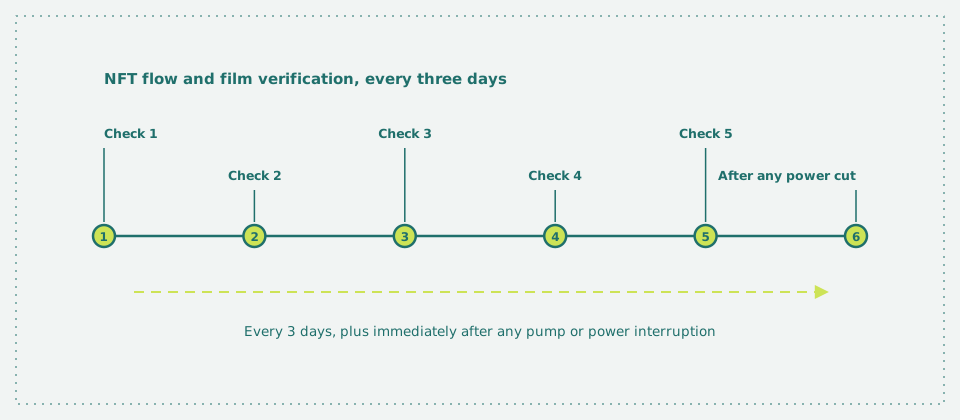
NFT Flow Check: five things to verify every three days
An NFT system has a very small buffer. The plants live on a film of water a few millimetres deep, and anything that changes the hydraulics of that film changes the crop within hours. A three-day check cycle catches every failure mode while it is still cheap to fix.
- Check 1Confirm the film spans the full channel width at the midpoint of each railSurface tension narrows the film as roots grow; a rail that was fine at week 1 can be split into two streams by week 5
- Check 2Look for any point where the film pools rather than movesA still pool under a root mat is where pythium establishes and it will not be visible from the inlet end
- Check 3Feel the return flow at the outlet; it should be a steady stream, not a trickleA trickle at the outlet means either a blocked filter or a failing impeller, both of which starve the rails within an hour
- Check 4Clear any root tip that has grown through a pot base into the channel floorRoots in the channel change the hydraulics for everything downstream of them
- Check 5Check reservoir level and top up with half-strength nutrient to the marked lineA full canopy on an NFT loop can lose 2-3 L per day, and a low reservoir makes the pump draw air
- After any power cutRun all five checks immediately, regardless of when the last one wasA pump stop during a hot afternoon can dry a root mat in under 45 minutes and the damage shows a day later
The film narrows as the roots grow
In week one a properly tuned rail has a film that spans the full channel width. By week five the root mat occupies a large fraction of the channel floor, and surface tension pulls the remaining film into two or three narrow streams. Those streams leave parts of the root mat dry, which shows up as patchy wilting along the rail rather than as a general problem. Checking the midpoint of each rail every three days catches the transition early enough to adjust the pump flow.
Stagnant pools are the beginning of every root disease
Water that stops moving loses its dissolved oxygen within a few hours, and a still pool sitting under a root mat is the ideal environment for pythium. These pools form at any point where the slope is locally flat — often where two channel sections join, or where a root has lifted the mat off the floor. They are invisible from the inlet end of the rail, which is why the check has to be walked along its whole length.
The outlet tells you about the whole loop
The return flow at the outlet is a single measurement that summarises filter condition, impeller condition and total flow. A steady stream is normal; a trickle means something upstream has degraded. Because flow rate falls gradually as a filter blinds, feeling the outlet is more sensitive than watching the rails, where a reduced flow often still looks adequate.
Power cuts are a scheduled event, not an emergency
Every NFT system at home will experience a power cut at some point, and the correct response is pre-planned rather than improvised. Root mats at 25 C can lose enough moisture in 45 minutes to cause permanent damage that only becomes visible the following day, when leaves go grey at the margins. After any interruption, run the full check immediately, including one pot lifted to inspect the roots directly.
Key points
- Verify the film spans the full channel width at each rail's midpoint
- Walk the whole rail looking for pooling, not just the inlet
- Feel the outlet flow; a trickle means a filter or impeller problem
- Clear root tips that grow through into the channel floor
- Repeat the full check immediately after any pump or power interruption
Sources
- Virginia Tech — https://www.hort.vt.edu/ghvegetables/documents/Hydroponics/Nutrient%20Film%20Technique%20Lettuce_LMorgan.pdf
- University of Padova — https://thesis.unipd.it/retrieve/cf7c45ea-4318-4977-aeeb-b05a8217ce63/Flaim_Gabriel.pdf
- Korean Journal of Horticultural Science — https://koreascience.kr/article/JAKO199911922406644.do
- Wageningen UR — https://edepot.wur.nl/403804
Please noteFlow rates and reservoir figures are general references for home NFT builds. Follow your nutrient label for mixing. This article is informational and is not professional horticultural advice.
- NFT Lettuce Rail: two 1.8 m channels, 24 plants, 30 days from plug to plate · Build manual · 28 Aug 2026
- Kratky Top-Off Calendar: what to do on days 1, 14, 24 and 35 · Maintenance calendar · 17 Aug 2026
- The DWC Weekly Log: six steps in the only order that gives you usable data · Maintenance calendar · 1 Sept 2026