Build manual · Nutrient film technique · Soft fruit
NFT Strawberry Gutter: 16 plants, 2.4 m of channel, and a slope that has to be exact
Strawberries in a nutrient film gutter outperform pot-grown plants by a wide margin, but they are far less forgiving than lettuce in the same channel. The root mat is denser, the drink is heavier, and a crowned plant sitting in a damp pocket will die without ever showing a symptom you can react to.
- Reservoir
- 50 Lworking volume
- Planting sites
- 16sites
- Pump
- 200 GPH757 L/h
- Air stones
- 1stones
- EC target
- 1.6 mS/cmtarget
- pH window
- 5.6 - 6.0pH
- Light at canopy
- 420 PPFDat leaf
- Photoperiod
- 13 hper day
- Cycle length
- 180 daysplant to harvest
Top-up routine — Fruiting strawberries on an 8 ft gutter drink 5-7 L per day; check daily and top up with 1.6 mS/cm nutrient, and run a full change every 3 weeks.
| Part | Specification | Qty | Substitute |
|---|---|---|---|
| NFT gutter | 2.4 m uPVC half-round, 110 mm wide, capped | 1 | Two 1.2 m lengths joined with a silicone sleeve if transport is a problem |
| Reservoir | 50 L opaque, with lid cut for the return | 1 | 40 L works but the daily draw of 16 fruiting plants leaves little margin |
| Pump | 800 L/h, 12 W, 1.5 m head | 1 | 500 L/h with a shorter 8 mm distribution line |
| Distribution line | 19 mm PVC with 16 x 2 L/h drippers set into the gutter floor | 1 | A soaker line laid along the gutter floor is cheaper and less precise |
| Net pots | 50 mm, spaced 15 cm in a single row | 16 | Staggered 90 mm pots allow 12 plants but each gets more root volume |
| Growing medium | Perlite 3-6 mm in the pots only, not the gutter | 4 L | Coir plugs alone hold too much water for a gutter root zone |
| Strawberry runners | Day-neutral, 6 weeks, 8 mm crown | 16 | Cold-stored bare-root runners planted in spring give the most even first flush |
| Fruiting nutrient | Two-part high-K, target 1.6 mS/cm | 1 L each | Dry salts: 1.7 g/L calcium nitrate plus 1.4 g/L potassium sulfate at peak fruit |
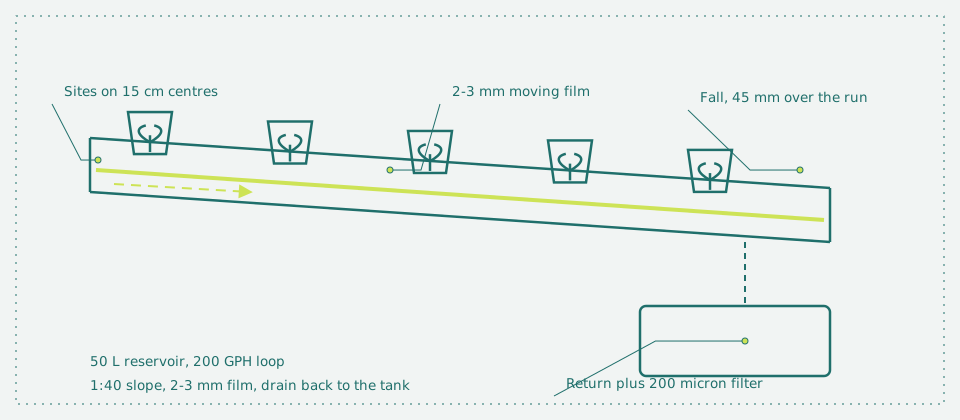
Give the gutter a 1:45 fall over its full length
That is 53 mm across 2.4 m. Strawberry roots form a dense mat in a gutter far faster than lettuce, and a mat in a shallow film is very sensitive to slope. Flatter than 1:60 and the film breaks into stagnant pools under the root mat; steeper than 1:30 and the film moves so fast that the mat stays thin and the plants dry between passes.
Set drippers into the floor, not above it
Sixteen 2 L/h drippers pushed through the gutter floor at 15 cm centres, each pointing upstream, spread the film evenly. Drippers mounted above the gutter splash the crowns and are the direct cause of botrytis in the first month, because strawberry crowns that stay wet for more than six hours are almost guaranteed to rot.
Plant so the crown sits proud of the pot rim
The crown — the thick fleshy junction where the leaves emerge — must sit level with or slightly above the perlite surface. Bury it even 5 mm and the plant sits in a damp pocket permanently; it will look healthy for three weeks and then collapse from the centre outwards with no warning.
Run 1.6 mS/cm at pH 5.8 from the start
Unlike most fruiting crops, strawberries do not want a hard push. 1.6 mS/cm at planting keeps them growing steadily, and during peak fruit you let the EC fall naturally from 1.7 towards 1.4 as the plants strip potassium out of the solution. Chasing the EC back up mid-flush with extra potassium causes leaf margin burn and does not increase fruit size.
De-blossom for three weeks, then stop
Remove every flower for the first 21 days. On a 16-plant gutter that is a real cost in early fruit, but it buys a root mat thick enough to carry continuous harvest for five months instead of two. Mark the calendar; after day 21 let everything flower and pollinate with a soft brush at midday for the first week.
Check the return filter every three days
Strawberry root mats shed fine brown fibre constantly and that fibre is exactly the size that blinds a 200 micron screen. A blinded filter raises the gutter water level, submerges the crowns and stops the film moving, all within a few hours. Cleaning it takes a minute and prevents the most common mid-season collapse.
Week 1-3
EC 1.6 · pH 5.8
- 24/7 pump
- De-blossom weekly
- Verify return filter twice a week
Week 4-8
EC 1.6-1.7 · pH 5.8
- Allow flowering and pollinate
- First harvest of early trusses around week 7
- Top up daily
Week 9-18
EC 1.7 falling to 1.4 · pH 5.8
- Pick every 2 days
- Remove senescent leaves weekly
- Full reservoir change every 3 weeks
Week 19-26
EC 1.5 · pH 5.9
- Second flush on fresh trusses
- Trim runners that reach the gutter floor
- Plan replacement runners for month 7
A strawberry root mat is ten times denser than lettuce
Sixteen strawberry plants fill a 2.4 m gutter with a fibrous mat 20-30 mm thick within eight weeks. That mat sits directly in the film and does two things at once: it slows the flow, and it sheds fibre into the return. A system that ran perfectly with lettuce will need the slope checked and the filter cleaned three times as often when strawberries go in.
Never wet the crown
Strawberry crowns have almost no tolerance for surface moisture. In a gutter, drip emitters mounted above the channel splash the crowns on every cycle and botrytis establishes in the first month with no other cause. Setting emitters into the floor so the water enters from below the root mat keeps the crown dry and the disease pressure near zero.
Let the EC fall during the flush
At peak fruit, sixteen plants strip potassium out of 50 L fast enough that a 1.7 mS/cm solution drifts down to 1.4 within four days. This is normal and desirable. Trying to hold the EC by adding potassium concentrate mid-flush raises the total salt load without raising the potassium available to the fruit, and the visible result is scorched leaf margins two weeks later.
Pollination is manual indoors
A greenhouse or balcony gutter has no wind and often no insects, and strawberry flowers are self-fertile but need mechanical agitation to release pollen. A soft artist's brush drawn across each open flower at midday for the first seven days of flowering is the difference between full, even berries and the small, one-sided fruit that comes from partial pollination.
Key points
- 1:45 slope across the full 2.4 m, re-checked after the root mat fills
- Drippers set into the gutter floor so the crowns never get splashed
- Plant with the crown level with or above the perlite surface
- Let EC drift from 1.7 down to 1.4 during peak fruiting
- Clean the 200 micron return filter every three days
Sources
- Virginia Tech — https://www.hort.vt.edu/ghvegetables/documents/Hydroponics/Nutrient%20Film%20Technique%20Lettuce_LMorgan.pdf
- Wageningen UR — https://edepot.wur.nl/403804
- Korean Journal of Horticultural Science — https://koreascience.kr/article/JAKO199911922406644.do
- University of Florida IFAS — https://edis.ifas.ufl.edu/publication/HS405
Please noteNutrient, pH and flow figures are general references for home NFT fruit systems. Confirm dosages against your product label. This article is informational and is not professional horticultural advice.
- DWC Strawberry Tower: 18 plants in 1.6 m of column, on a 30 L reservoir · Build manual · 20 Sept 2026
- NFT Lettuce Rail: two 1.8 m channels, 24 plants, 30 days from plug to plate · Build manual · 28 Aug 2026
- Kratky Lettuce Bucket: a 12 L no-pump system that runs 35 days on one charge · Build manual · 11 Aug 2026
- DWC Basil Tote: 20 L, six plants, and a pump that quietly decides everything · Build manual · 20 Aug 2026