Nutrient chart · Leafy greens
Chard and Spinach EC and pH Chart: the long-cycle greens that run 90 days
Chard, spinach and beet greens are cut-and-come-again crops that stay in the same reservoir for three months. That long residence time changes the nutrient problem completely: it is no longer about hitting the right number, it is about holding a stable one while the plant removes anions faster than cations.
| Stage | EC | pH | N-P-K | Notes |
|---|---|---|---|---|
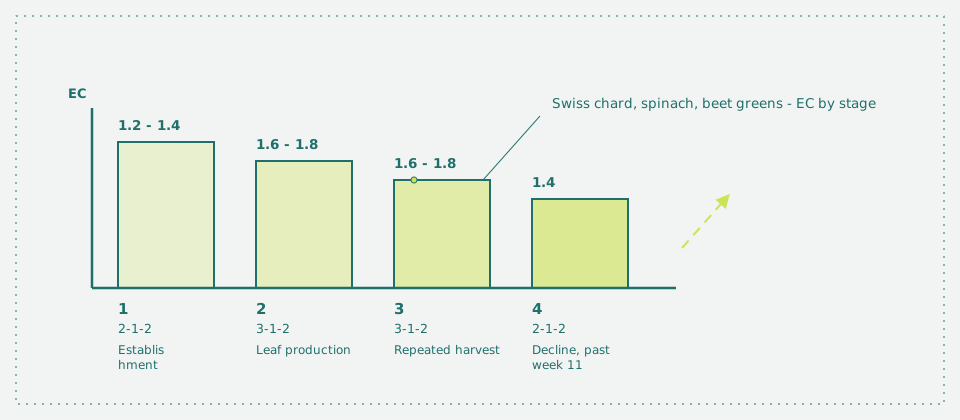
| Establishment | 1.2 - 1.4 | 6.0 - 6.2 | 2-1-2 | Chard germinates in a corky seed cluster; thin before raising the EC |
| Leaf production | 1.6 - 1.8 | 6.0 - 6.4 | 3-1-2 | Continuous cutting means continuous nitrogen demand for months |
| Repeated harvest | 1.6 - 1.8 | 6.2 - 6.5 | 3-1-2 | Hard water pushes pH up fast on this crop; check after every top-up |
| Decline, past week 11 | 1.4 | 6.2 - 6.5 | 2-1-2 | Leaf size plateaus; reduce rather than push, and start replacement seedlings |
These crops run at a higher pH than lettuce, and that is fine
Chard and spinach perform well between pH 6.0 and 6.5, and spinach in particular is more tolerant of the upper end than lettuce is. Pushing a chard bucket down to 5.8 costs you nothing directly but it also creates a wider swing across the following weeks, because the plant will pull the pH back up quickly. Setting the target at 6.2 and accepting a drift to 6.5 is more stable than fighting for 5.9 every few days.
The pH climb is caused by unequal uptake
These crops take up nitrate and phosphate — anions — faster than they take up calcium, magnesium and potassium. Every anion removed leaves a bicarbonate or hydroxide behind, and the solution pH rises as a result. On a 90-day crop in an 8 L bucket the climb is fast and constant, which is why checking pH after every top-up matters more here than on any short-cycle crop.
Hard water doubles the effect
Water at 0.4 mS/cm or above arrives with bicarbonate already dissolved in it, and that bicarbonate buffers against the acid you add while simultaneously feeding the pH climb. Chard on hard water typically needs two to three times as much pH down as the same crop on soft water, and the buffering means you should add acid, wait twenty minutes, then measure again rather than adding until the meter reads what you want.
Do not chase a bigger leaf in the last month
From about week 11 chard leaf size plateaus no matter what the reservoir reads, because the limiting factor is the age of the root system rather than nutrition. Raising the EC at this point produces leaves with higher nitrate and tougher petioles. The right move is to reduce the charge slightly and start replacement seedlings so a fresh bucket is ready.
Key points
- 1.6-1.8 mS/cm through the whole production phase
- Aim for pH 6.2 and accept 6.5; fighting for 5.9 is unstable
- pH climbs constantly because anion uptake exceeds cation uptake
- On hard water, add acid, wait 20 minutes, then measure again
- Past week 11 reduce the charge and start replacements rather than pushing
Sources
- Korean Journal of Horticultural Science — https://koreascience.kr/article/JAKO199911922406644.do
- University of Padova — https://thesis.unipd.it/retrieve/cf7c45ea-4318-4977-aeeb-b05a8217ce63/Flaim_Gabriel.pdf
- SARE — https://projects.sare.org/wp-content/uploads/Leafy-Greens-Hydroponic-publication2022.pdf
Please noteThe EC and pH values given are general references for long-cycle leafy crops and vary with your water supply and nutrient brand. Follow your product label. This is informational content and not professional horticultural advice.
- Kratky Swiss Chard: two plants, one recharge, three months of cutting · Build manual · 8 Oct 2026
- Leafy Green EC and pH Chart by Stage: lettuce, mizuna, tatsoi, pak choi · Nutrient chart · 14 Aug 2026
- Kratky Lettuce Bucket: a 12 L no-pump system that runs 35 days on one charge · Build manual · 11 Aug 2026
- Soft Herb EC and pH Chart by Stage: basil, mint, parsley, coriander, dill · Nutrient chart · 24 Aug 2026