Nutrient chart · Leafy greens
Leafy Green EC and pH Chart by Stage: lettuce, mizuna, tatsoi, pak choi
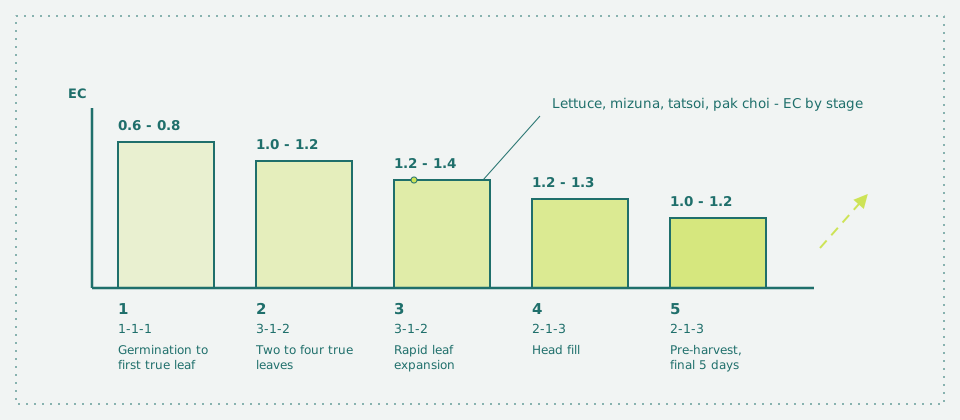
Leafy greens are the most forgiving group in hydroponics but they are not uniform: lettuce wants a moderate charge, brassica greens want more nitrogen, and every one of them punishes you for pushing pH above 6.5. This chart gives the stage-by-stage targets and explains what changes in the plant at each step.
| Stage | EC | pH | N-P-K | Notes |
|---|---|---|---|---|
| Germination to first true leaf | 0.6 - 0.8 | 5.8 - 6.0 | 1-1-1 | Seed reserves cover this stage; a full charge here scorches the radicle before it reaches the medium |
| Two to four true leaves | 1.0 - 1.2 | 5.8 - 6.0 | 3-1-2 | First real uptake of nitrogen; this is when a Kratky bucket should be charged |
| Rapid leaf expansion | 1.2 - 1.4 | 5.9 - 6.2 | 3-1-2 | Peak demand; EC falls 0.1-0.2 per week as the canopy closes |
| Head fill | 1.2 - 1.3 | 6.0 - 6.2 | 2-1-3 | Nitrogen demand flattens; pushing it higher produces tipburn rather than weight |
| Pre-harvest, final 5 days | 1.0 - 1.2 | 6.0 - 6.2 | 2-1-3 | A slight drop reduces nitrate accumulation in the leaf tissue |
Why the nitrogen ratio falls at head fill
Through the expansion phase a leafy green is building leaf area and needs nitrogen above all else, which is what a 3-1-2 ratio supplies. Once the canopy closes and the plant starts filling the head, additional nitrogen goes into nitrate stored in the leaf rather than into new growth, and nitrate accumulation is exactly what causes tipburn and a flat, watery flavour. Dropping toward 2-1-3 for the last ten days shifts the plant toward finishing.
The pH window is narrower than most charts suggest
The commonly quoted 5.5-6.5 range (per Korean Journal of Horticultural Science) is technically correct for nutrient availability but too wide to be useful. Above 6.4, iron and manganese precipitate out and lettuce shows interveinal yellowing on new leaves within a week. Below 5.4, calcium uptake stalls and new leaves crinkle and cup. In practice a leafy green system runs best when held between 5.8 and 6.2, which happens to be the range where the least adjustment is needed.
Soft water and hard water need different charts
Starting water above 0.5 mS/cm already carries a meaningful load of calcium and bicarbonate. On that supply, the same 1.3 mS/cm target is achieved with less nutrient concentrate, and the pH will climb faster because of the bicarbonate. On soft water below 0.1 mS/cm you will need magnesium supplementation that the label formula assumes is already present in the tap water.
Reading the leaf before the meter
A meter tells you what is in the solution; the plant tells you what it is actually taking up. Uniformly pale lower leaves means the EC has drifted down and the plant is redistributing nitrogen. Yellowing between the veins of new leaves with green veins means the pH has climbed and iron is locked out. Brown, brittle edges on inner leaves means the plant is transpiring faster than it can move calcium, which is a heat and airflow problem no EC adjustment will fix.
Key points
- 0.6-0.8 mS/cm until the first true leaf; a full charge too early burns the root
- 1.2-1.4 mS/cm through expansion, then back off to 1.2-1.3
- Hold pH 5.8-6.2; above 6.4 iron locks out and new leaves yellow
- Drop toward a 2-1-3 ratio in the last ten days to reduce nitrate
- Tipburn is transpiration, not nutrition; check airflow before changing the reservoir
Sources
- Korean Journal of Horticultural Science — https://koreascience.kr/article/JAKO199911922406644.do
- University of Padova — https://thesis.unipd.it/retrieve/cf7c45ea-4318-4977-aeeb-b05a8217ce63/Flaim_Gabriel.pdf
- SARE — https://projects.sare.org/wp-content/uploads/Leafy-Greens-Hydroponic-publication2022.pdf
- Wageningen UR — https://edepot.wur.nl/403804
Please noteThese EC and pH figures are general references for common leafy cultivars and will vary with your water supply, nutrient brand and climate. Always mix to your product label and treat these numbers as a starting point. This is informational content, not professional horticultural advice.
- Lettuce Head Finish Chart: what changes in the last ten days · Nutrient chart · 30 Sept 2026
- Kratky Lettuce Bucket: a 12 L no-pump system that runs 35 days on one charge · Build manual · 11 Aug 2026
- NFT Lettuce Rail: two 1.8 m channels, 24 plants, 30 days from plug to plate · Build manual · 28 Aug 2026