Maintenance calendar · Maintenance
Reservoir Sanitation Calendar: what to clean, and how often it actually matters
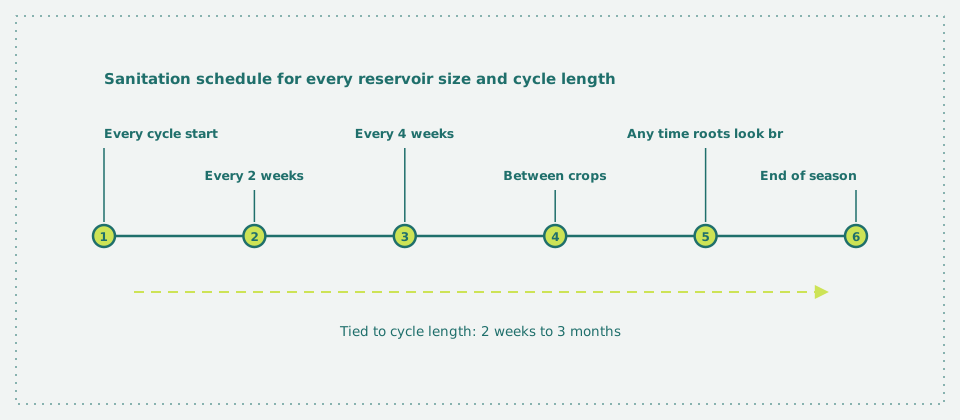
Sanitation in a home hydroponic system is not about sterility, which is impossible to maintain, it is about keeping the bacterial and algal population below the level at which it competes with the crop. There are five moments where cleaning genuinely changes the outcome, and the rest is optional.
- Every cycle startScrub the reservoir, lid and any submerged fittings with hot water and a dedicated brushBiofilm on the wall seeds the new crop; a separate brush avoids carrying anything in from other tasks
- Every 2 weeksCheck and clean the return filter and any inline screenA blinded filter raises the water level, submerges the crowns and stalls the flow, all within a few hours
- Every 4 weeksSoak airstones in hot water and check the pump inlet for root fragmentsScaled stones still look active from above while dissolved oxygen at the bottom falls
- Between cropsRun a 1 % hydrogen peroxide solution through the whole system for 20 minutes, then flush with plain waterPeroxide reaches the tubing and fittings that a manual scrub cannot; the plain flush removes the residue
- Any time roots look brown or slickDump the reservoir, clean the stones, and recharge at half strength for one weekPythium spreads fastest in a warm, nutrient-rich reservoir; halving the strength slows it while the roots recover
- End of seasonDry the whole system completely before storageAny residual moisture in tubing over a storage period becomes a biofilm reservoir for the next season
Biofilm on the reservoir wall seeds the next crop
A reservoir that has run a full crop develops a slick film on the walls and lid, mostly bacterial and often including organisms that were harmless while the plant was healthy. When that reservoir is refilled, the film is the starting inoculum for the next crop, and the new plant meets a population that has already established itself. Scrubbing the walls with hot water at every cycle start takes two minutes and is the highest-value cleaning action in the whole system.
The return filter is the most neglected part
On any recirculating system the filter is where organic matter collects, and where it decays. A filter that is working is fine; a filter that is blinding is worse than no filter at all, because it raises the water level upstream, submerges crowns that should stay dry and reduces flow to the point where the film stops moving. Checking it every two weeks, and immediately after any crop change, prevents all three.
Hydrogen peroxide does what a brush cannot
A manual scrub reaches the reservoir walls and the larger fittings. It does not reach inside the tubing, the drip stakes or the inside of a drain elbow. A 20-minute circulation of 1 % hydrogen peroxide solution reaches all of those, then a plain water flush removes the residue before the next charge. This is worth doing between crops rather than every week; at higher frequency it also removes the harmless biofilm that competes with the harmful one.
Dry storage matters more than most people think
At the end of a season, tubing and fittings that are stored damp grow a biofilm over weeks that no amount of rinsing at the start of the next season will remove completely. Draining and drying every component thoroughly before storage costs an afternoon once a year and means the next season starts from a clean baseline rather than a partially colonised one.
Key points
- Scrub the reservoir walls and lid at every cycle start
- Check the return filter every two weeks and after every crop change
- Soak airstones and check the pump inlet monthly
- Circulate 1 % hydrogen peroxide between crops, then flush with plain water
- Dry everything completely before storing it for a season
Sources
- Virginia Tech — https://www.hort.vt.edu/ghvegetables/documents/Hydroponics/Nutrient%20Film%20Technique%20Lettuce_LMorgan.pdf
- University of Padova — https://thesis.unipd.it/retrieve/cf7c45ea-4318-4977-aeeb-b05a8217ce63/Flaim_Gabriel.pdf
- Korean Journal of Horticultural Science — https://koreascience.kr/article/JAKO199911922406644.do
- University of Illinois Extension — https://extension.illinois.edu/sites/default/files/illinois_extension_hydroponics_handouts.pdf
Please noteThe cleaning intervals and concentrations here are general references for home systems. Handle hydrogen peroxide with appropriate care and follow the product's safety instructions. This article is informational and is not professional horticultural advice.
- The DWC Weekly Log: six steps in the only order that gives you usable data · Maintenance calendar · 1 Sept 2026
- Dutch Bucket Rotation: resetting the row between crops in one afternoon · Maintenance calendar · 6 Oct 2026
- Kratky Top-Off Calendar: what to do on days 1, 14, 24 and 35 · Maintenance calendar · 17 Aug 2026
- NFT Flow Check: five things to verify every three days · Maintenance calendar · 22 Sept 2026