Build manual · Dutch bucket · Fruiting crops
Dutch Bucket Peppers: four plants on 80 L, pruned to two stems for double the fruit size
Peppers in Dutch buckets produce better than peppers in soil, but they punish two mistakes harder than tomatoes do: an early nutrient spike and uneven irrigation. Get the establishment phase right and four plants will crop continuously for five months on an 80 L reservoir.
- Reservoir
- 80 Lworking volume
- Planting sites
- 4sites
- Pump
- 300 GPH1136 L/h
- Air stones
- 2stones
- EC target
- 2.2 mS/cmtarget
- pH window
- 5.8 - 6.2pH
- Light at canopy
- 500 PPFDat leaf
- Photoperiod
- 15 hper day
- Cycle length
- 140 daysplant to harvest
Top-up routine — Four mature pepper plants draw 5-8 L per day; top up daily with full-strength nutrient to the 70 L mark and change the whole reservoir every 3 weeks.
| Part | Specification | Qty | Substitute |
|---|---|---|---|
| Dutch buckets | 11 L with 25 mm side drain | 4 | 15 L pots give more root volume for large bell varieties and tolerate a missed cycle |
| Reservoir | 80 L opaque tote | 1 | 60 L is enough for four plants but leaves less margin on hot days |
| Pump | 1200 L/h, 18 W, 2 m head | 1 | Two 600 L/h pumps on parallel lines add redundancy for a long season |
| Drip line | 19 mm main with 8 x 4 L/h drippers, 2 per bucket | 1 | Equal-length 6 mm spaghetti spurs from a single manifold |
| Growing medium | Perlite 3-8 mm, 9 L per bucket | 36 L | 70/30 perlite and coco holds more water and buffers one missed cycle |
| Pepper seedlings | 6 weeks, 20 cm, first fork visible | 4 | Buy in transplants; peppers started from seed indoors need 8 weeks and a heat mat |
| Fruiting nutrient | Two-part, high K, 2.2 mS/cm target | 1 L each | Dry salts: 1.9 g/L calcium nitrate plus 1.1 g/L potassium sulfate at peak |
| Support stakes | 1.2 m bamboo or steel, one per plant | 4 | A horizontal string trellis across all four plants is faster to install and easier to adjust |
Set the drains and level the row
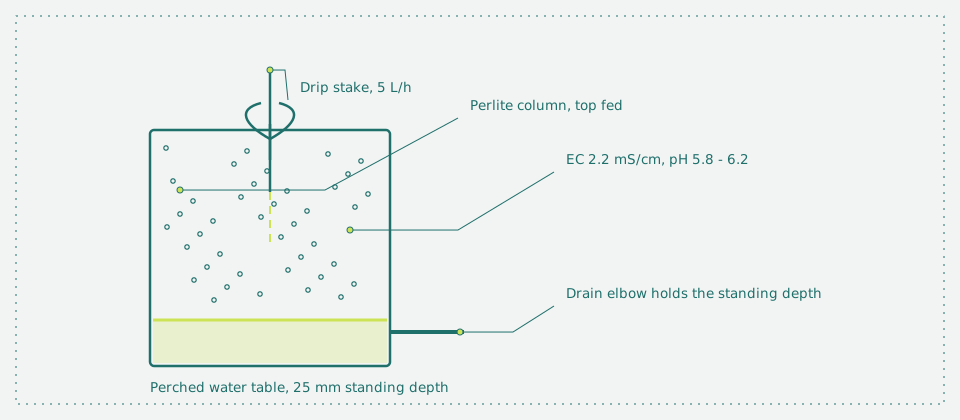
All four buckets must sit at the same height and their 25 mm drain elbows must all face the same return line. A bucket 20 mm lower than its neighbour will drain first and run dry while the others are still full, and by week six that plant is visibly smaller with no obvious cause.
Establish at 1.4, not 2.2
Peppers are slow to establish and pushing a young transplant to fruiting strength stalls it for three weeks. Start at 1.4 mS/cm, move to 1.8 when the first fork appears, and reach 2.2 only once two fruits have set per plant. Peppers are more sensitive to an early EC spike than tomatoes are.
Cycle 4 times a day in summer, twice in winter
Four five-minute cycles spread across the day keeps the perlite moist without letting the perched water table rise into the crown. In cool weather two cycles are enough, and running four anyway keeps the root zone too wet and slows the plants down. Adjust by season, not by schedule habit.
Prune to two or three main stems
A pepper plant left unpruned indoors produces a dense bush with many small fruit. Taking it to two or three main stems and removing every sucker that forms in the leaf axils concentrates the plant's resources and roughly doubles the size of the fruit, which matters more than the count.
Calcium matters at fruit set
Blossom-end rot on peppers appears when the plant cannot move calcium to a rapidly expanding fruit, which normally means irregular watering rather than a shortage in the solution. Keeping the cycles even and the EC stable does more than adding calcium. A sudden dry cycle during fruit expansion will produce rot on the next set regardless of what is in the reservoir.
Flush weekly and change the reservoir every three weeks
Perlite accumulates salts just above the perched water table. One weekly plain water cycle, drained away rather than recirculated, keeps the root zone EC close to what the reservoir reads. A full change every three weeks resets what the flush cannot remove.
Week 1-2
EC 1.4 · pH 6.0
- 2 cycles per day
- Stake and tie
- Watch for transplant shock in the first 4 days
Week 3-5
EC 1.8 · pH 6.0
- First fork; prune to 2-3 stems
- 3 cycles per day
- Weekly plain-water flush
Week 6-10
EC 2.2 · pH 6.1
- Fruit set; full EC
- 4 cycles per day in summer
- Reservoir change every 3 weeks
Week 11-18
EC 2.2 · pH 6.1
- Harvest green or leave to colour
- Remove every sucker weekly
- Daily top-up with full-strength nutrient
Week 19-20
EC 2.0 · pH 6.1
- Final flush with plain water
- Remove plants and sterilise buckets for the next cycle
Peppers establish slowly and hate being rushed
A pepper transplant takes about two weeks to grow roots into a new medium, compared with one week for a tomato. Pushing the EC to fruiting strength during that window burns the new root tips as they form, and the plant responds by dropping its first flowers and sitting still for three weeks. Starting at 1.4 mS/cm and stepping up only when the first fork opens costs nothing and avoids the entire problem.
Pruning to two stems doubles fruit size
Indoor peppers branch far more than they would outdoors because there is no wind to break the canopy. Left alone, a plant produces dozens of small fruit on weak wood. Cutting back to two or three main stems and removing every sucker in the leaf axils redirects that energy into fewer but much larger fruit, and a two-stem plant is also far easier to keep staked and inspect for pests.
Irrigation consistency beats every additive
Blossom-end rot in peppers is a calcium transport failure during rapid fruit expansion, and it almost always follows a dry cycle or a sudden EC swing rather than a deficiency in the reservoir. Adding calcium to a solution that already contains enough does nothing. Holding the cycle count steady, especially on the first hot week of the season, is what actually prevents it.
One row height, one drain direction
Four buckets on a Dutch bucket row have to be level with each other to within a few millimetres, and their drains must all run the same way into the return. Uneven buckets create one plant that always drains first and one that always stands wet, and those two plants produce differently all season for reasons that are invisible unless you check with a level.
Key points
- Establish at 1.4 mS/cm and step to 2.2 only after two fruit set
- Prune to two or three main stems; remove every axillary sucker weekly
- Four 5-minute cycles in summer, two in winter
- Level the row to a few millimetres and point all drains the same way
- Weekly plain-water flush plus a full change every three weeks
Sources
- Virginia Tech — https://www.hort.vt.edu/ghvegetables/documents/Hydroponics/Nutrient%20Film%20Technique%20Lettuce_LMorgan.pdf
- Wageningen UR — https://edepot.wur.nl/403804
- Korean Journal of Horticultural Science — https://koreascience.kr/article/JAKO199911922406644.do
- University of Arizona CEAC — https://ceac.arizona.edu/sites/default/files/Chapter%2010.pdf
Please noteThe EC, pH, irrigation and pruning figures here are general home-system references and vary with cultivar and climate. Follow your nutrient label. This article is informational and is not professional horticultural advice.
- Dutch Bucket Tomatoes: two indeterminate plants, 60 L of reservoir, 17 weeks of harvest · Build manual · 5 Sept 2026
- NFT Strawberry Gutter: 16 plants, 2.4 m of channel, and a slope that has to be exact · Build manual · 3 Oct 2026
- Kratky Lettuce Bucket: a 12 L no-pump system that runs 35 days on one charge · Build manual · 11 Aug 2026
- DWC Basil Tote: 20 L, six plants, and a pump that quietly decides everything · Build manual · 20 Aug 2026