Build manual · Dutch bucket · Fruiting crops
Dutch Bucket Tomatoes: two indeterminate plants, 60 L of reservoir, 17 weeks of harvest
Dutch buckets are the standard commercial layout for greenhouse tomatoes and peppers, and they scale down to two plants without losing what makes them work: a drain elbow that creates a perched water table, a recirculating drip line, and a medium that drains fast enough to keep the root zone breathing.
- Reservoir
- 60 Lworking volume
- Planting sites
- 2sites
- Pump
- 250 GPH946 L/h
- Air stones
- 2stones
- EC target
- 2.4 mS/cmtarget
- pH window
- 5.8 - 6.3pH
- Light at canopy
- 550 PPFDat leaf
- Photoperiod
- 16 hper day
- Cycle length
- 120 daysplant to harvest
Top-up routine — Two mature indeterminate tomatoes pull 6-9 L per day; check the 60 L reservoir daily and top up with full-strength nutrient, never plain water.
| Part | Specification | Qty | Substitute |
|---|---|---|---|
| Dutch buckets | 11 L, with a 25 mm drain elbow 25 mm up the side wall | 2 | Standard 11 L nursery pots lined with black poly and fitted with a bulkhead drain |
| Reservoir | 60 L opaque tote with lid | 1 | Anything 50-80 L; below 50 L the EC of two heavy feeders swings too fast |
| Submersible pump | 1000 L/h, 15 W, 1.8 m head | 1 | Two 500 L/h pumps on separate lines let you run a spare without replumbing |
| Drip stakes | 2 per bucket, 4 L/h pressure-compensating | 4 | Open 4 mm spaghetti line staked at the stem base works if you keep the runs equal length |
| Growing medium | Coarse perlite 3-8 mm, 9 L per bucket | 18 L | 60/40 perlite and coco coir holds more water and tolerates one missed cycle |
| Air pump and stones | 3 W dual outlet, two 5 cm stones | 1 | A single strong stone directly under the pump intake reduces dead spots |
| Tomato seedlings | Indeterminate beefsteak or cherry, 5 weeks, first truss visible | 2 | Determinate bush varieties work but crop in one six-week window instead of continuously |
| Two-part fruiting nutrient | Calcium nitrate plus high-K bloom formula | 1 L each | Dry salts: 2.2 g/L calcium nitrate plus 1.0 g/L potassium sulfate blend at peak |
| Trellis twine | UV-stable poly, 3 m per plant | 6 m | Bamboo canes plus soft ties, but you must retie every 10 days as stems thicken |
Fit the drain elbow at exactly 25 mm
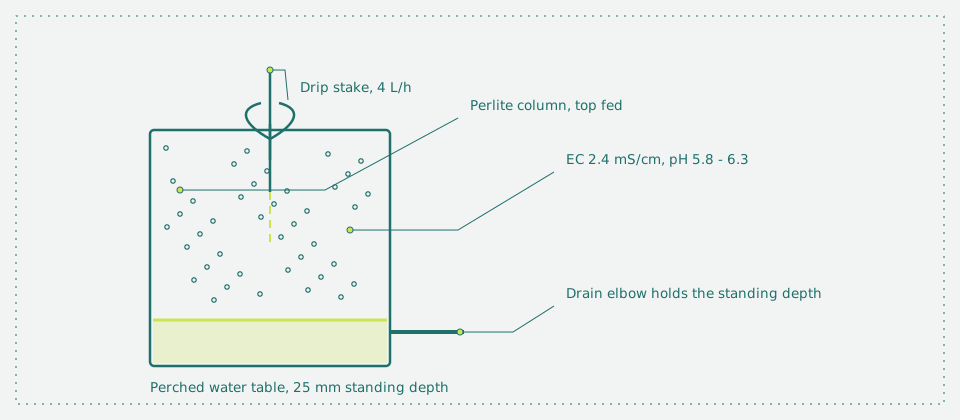
The elbow height sets the perched water table inside the bucket. At 25 mm the bottom of the perlite column stays permanently saturated and the upper 250 mm drains and breathes. Lower than 15 mm and the bucket dries between cycles; higher than 40 mm and the saturated zone reaches the crown and the stem base rots.
Plumb one manifold, not four hoses
Run a single 19 mm line from the pump around the buckets and tee off to each pair of drip stakes with equal-length 6 mm spurs. Unequal runs mean the near bucket floods and the far one never gets enough, and by week eight the two plants look like different varieties.
Move to the bucket two weeks before you expect flowers
Transplant a five-week seedling with its first truss just visible. It needs about 14 days in the bucket to establish before the first flowers open, and a plant that is still settling when it flowers will drop that entire first truss.
Start at 1.6 and climb to 2.4 by the third truss
A young tomato plant cannot use a peak-flower nutrient strength. Start at 1.6 mS/cm when the first truss sets, move to 2.0 when the second truss is marble-sized, and reach 2.4 by the third. Jumping straight to 2.4 burns the root tips and stalls the plant for two weeks.
Flush the perlite weekly
Perlite holds salts in the zone right above the perched water table. Once a week, run plain pH 6.0 water for one full cycle and let it drain away instead of recirculating. Skipping this is how a bucket that reads 2.4 mS/cm in the reservoir still shows potassium deficiency at the leaf margins by week ten.
Top the reservoir daily with full-strength feed
Two indeterminate plants at peak pull 6-9 L a day out of a 60 L reservoir. If you replace that with plain water, the EC halves in three days and blossom-end rot appears on the next truss. Mix a fresh full-strength batch and top up to the mark; a complete reservoir change every three weeks handles the rest.
Week 1-2
EC 1.6 · pH 6.0
- 2 cycles per day, 5 min each
- Tie to the trellis as the stem extends
- Remove side shoots below the first truss
Week 3-4
EC 2.0 · pH 6.1
- First truss sets; bump EC
- Pollinate by tapping the truss at midday
- Weekly plain-water flush
Week 5-8
EC 2.4 · pH 6.2
- Third truss; full EC reached
- Remove leaves below the ripening truss only
- Daily top-up with full-strength nutrient
Week 9-14
EC 2.4 · pH 6.2
- Harvest continuously, never strip a whole truss at once
- Watch the leaf margins for potassium draw-down
- Full reservoir change every 3 weeks
Week 15-17
EC 2.2 · pH 6.2
- Stop the growing tip two trusses above the last set fruit
- Reduce cycles to 2 per day
- Final flush with plain water in the last week
The drain height is the entire design
Every Dutch bucket holds a permanent saturated layer at the bottom, with everything above it draining freely. That layer is what keeps the plant alive between irrigation cycles. Fit the elbow at 25 mm of standing depth and a mature tomato can go six hours without a cycle in cool weather. Fit it at 10 mm and the same plant is wilting by mid-afternoon.
Tomatoes are fed on a curve, not a constant
A tomato that starts out at flowering strength stalls; a tomato that gets pushed to 2.4 mS/cm while it is still establishing burns its root tips and takes two weeks to recover. The workable curve is 1.6 at first truss set, 2.0 when the second truss is marble-sized, and 2.4 once the third truss has set. Blossom-end rot is far more often caused by a sudden swing in EC or a dry cycle than by an absolute shortage of calcium.
Salt accumulates where the drainage stops
Perlite wicks solution upward from the perched water table and then dries, depositing salts in a band just above it — exactly where the feeder roots sit. A reservoir reading of 2.4 mS/cm can coexist with a root-zone EC closer to 4.0. One weekly flush of plain pH-adjusted water, run until it drains away, is the whole remedy.
Trellising determines how long the plant lives
An indeterminate tomato under 550 PPFD can keep producing for five months if it is supported properly and the side shoots are removed. Twine on a horizontal wire, wound around the stem once a week in the same direction the plant naturally spirals, is faster and gentler than clips or ties. A plant that flops over will kink its vascular tissue at the bend and lose the truss above it.
Key points
- Drain elbow at 25 mm standing depth; this is the setting that matters most
- Feed on a curve: 1.6 to 2.0 to 2.4 mS/cm as trusses set
- Top up daily with full-strength nutrient, not plain water
- One weekly plain-water flush prevents salt build-up above the drain
- Stop the growing tip two trusses above the last set fruit
Sources
- Virginia Tech — https://www.hort.vt.edu/ghvegetables/documents/Hydroponics/Nutrient%20Film%20Technique%20Lettuce_LMorgan.pdf
- Wageningen UR — https://edepot.wur.nl/403804
- Korean Journal of Horticultural Science — https://koreascience.kr/article/JAKO199911922406644.do
- University of Arizona CEAC — https://ceac.arizona.edu/sites/default/files/Chapter%2010.pdf
Please noteEC, pH and irrigation figures are general references for home Dutch bucket systems and vary with cultivar, climate and nutrient brand. Follow your product label. This article is informational and is not professional horticultural advice.
- Kratky Lettuce Bucket: a 12 L no-pump system that runs 35 days on one charge · Build manual · 11 Aug 2026
- DWC Basil Tote: 20 L, six plants, and a pump that quietly decides everything · Build manual · 20 Aug 2026
- NFT Lettuce Rail: two 1.8 m channels, 24 plants, 30 days from plug to plate · Build manual · 28 Aug 2026
- Fruiting Crop EC and pH Chart by Stage: tomato, pepper, cucumber · Nutrient chart · 10 Sept 2026