Nutrient chart · Leafy greens
Lettuce Head Finish Chart: what changes in the last ten days
Most lettuce guides stop at the vegetative stage. The final ten days are where tipburn appears, where shelf life is won or lost, and where the plant's nitrogen demand changes direction completely. This is the chart for that window.
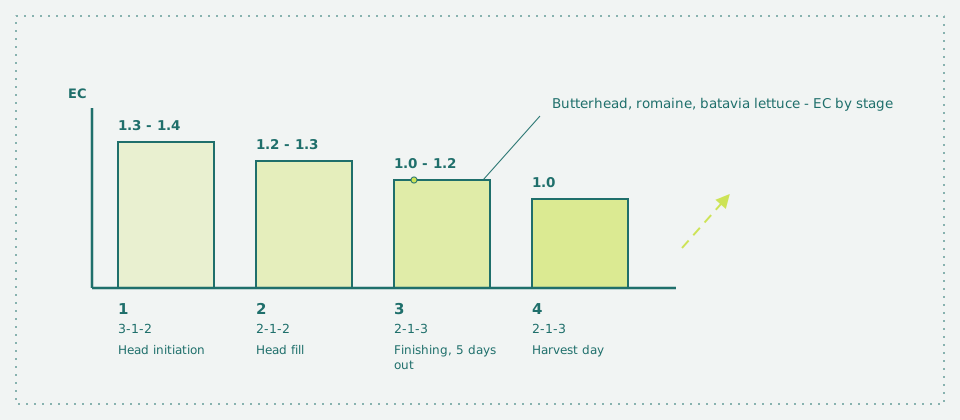
| Stage | EC | pH | N-P-K | Notes |
|---|---|---|---|---|
| Head initiation | 1.3 - 1.4 | 5.9 - 6.1 | 3-1-2 | Leaves stop expanding outward and start folding inward |
| Head fill | 1.2 - 1.3 | 6.0 - 6.2 | 2-1-2 | Nitrogen demand flattens; the plant is now mostly storing water and carbohydrate |
| Finishing, 5 days out | 1.0 - 1.2 | 6.0 - 6.2 | 2-1-3 | A deliberate drop reduces tissue nitrate and improves shelf life |
| Harvest day | 1.0 | 6.0 - 6.2 | 2-1-3 | Cut in the morning when turgor is highest; do not water the night before |
Nitrogen demand flattens at head initiation
While a lettuce is expanding outward it is building new leaf area continuously and pulling nitrogen hard. Once the leaves start folding inward, growth is largely cell expansion and water storage, and nitrogen uptake levels off. Continuing to feed at the expansion rate at this point does not produce a bigger head; it produces a head with more nitrate in the tissue, which is both the cause of tipburn and the reason a head goes limp within two days of harvest.
The deliberate drop in the last five days
Lowering the EC from 1.3 to 1.0 over the final five days is a standard commercial practice and it is worth doing at home. The plant continues to grow at nearly the same rate while taking up less nitrate, and the resulting tissue holds up noticeably longer in the fridge. On a Kratky bucket, this happens naturally because the level is falling — which is one more reason not to top up a nearly finished lettuce.
Tipburn is decided in this window, not earlier
Tipburn shows up on the inner leaves at head fill because those leaves are the ones expanding fastest in the most enclosed part of the canopy, where humidity is highest and transpiration is lowest. Low transpiration means calcium is not being pulled into those leaves, regardless of how much is in the solution. Improving airflow and reducing heat in the last ten days does more than any change to the reservoir.
Harvest timing changes shelf life more than nutrition
Cutting in the early morning when the plant is fully turgid, and not watering the night before so the tissue is not carrying excess water, makes a bigger difference to how long a head keeps than anything done to the nutrient solution. Cool the head quickly after cutting; lettuce loses quality roughly four times faster at 20 C than at 4 C.
Key points
- Stop feeding at expansion strength once the head begins to fold
- 1.2-1.3 mS/cm through head fill, dropping to 1.0 in the last five days
- Tipburn is decided by airflow and humidity in this window
- Do not top up a Kratky bucket in the final week; the falling EC is correct
- Harvest in the morning, do not water the night before, cool immediately
Sources
- Korean Journal of Horticultural Science — https://koreascience.kr/article/JAKO199911922406644.do
- University of Padova — https://thesis.unipd.it/retrieve/cf7c45ea-4318-4977-aeeb-b05a8217ce63/Flaim_Gabriel.pdf
- SARE — https://projects.sare.org/wp-content/uploads/Leafy-Greens-Hydroponic-publication2022.pdf
Please noteThese EC and pH values are general references for common lettuce cultivars and vary with water supply, climate and nutrient brand. Mix to your product label; this article is informational and not professional horticultural advice.
- Leafy Green EC and pH Chart by Stage: lettuce, mizuna, tatsoi, pak choi · Nutrient chart · 14 Aug 2026
- Kratky Lettuce Bucket: a 12 L no-pump system that runs 35 days on one charge · Build manual · 11 Aug 2026
- NFT Lettuce Rail: two 1.8 m channels, 24 plants, 30 days from plug to plate · Build manual · 28 Aug 2026