Build manual · Kratky still water · Herbs
Kratky Herb Jars: three 1 L windowsill jars that beat a supermarket pot by week six
A supermarket herb pot costs more than the whole setup described here and dies in ten days. Three opaque mason jars, a bag of clay pebbles and one bottle of nutrient will produce cut mint, Thai basil and parsley from a windowsill for two months per charge, with no pump and no noise.
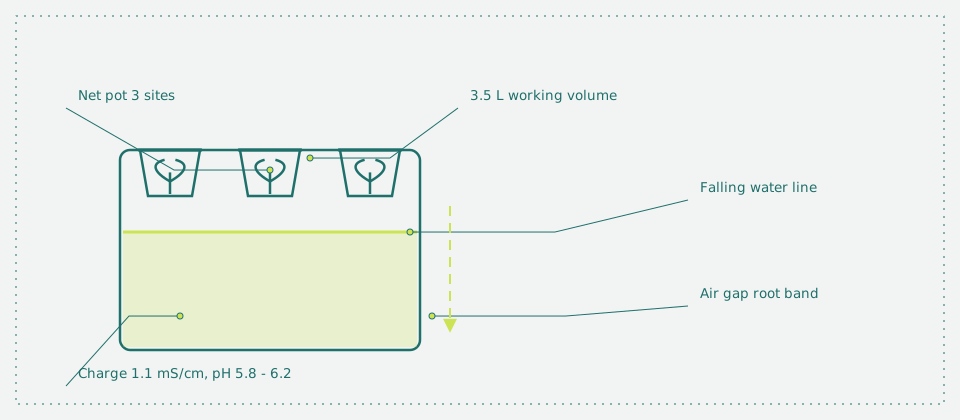
- Reservoir
- 3.5 Lworking volume
- Planting sites
- 3sites
- Pump
- nonepassive
- Air stones
- 0not required
- EC target
- 1.1 mS/cmtarget
- pH window
- 5.8 - 6.2pH
- Light at canopy
- 180 PPFDat leaf
- Photoperiod
- 15 hper day
- Cycle length
- 60 daysplant to harvest
Top-up routine — A 3.5 L jar of three herbs needs a 200 mL top-up roughly every 5 days; mark the starting line with tape so you never overfill.
| Part | Specification | Qty | Substitute |
|---|---|---|---|
| Glass mason jars | 1 L wide mouth, painted or sleeved to block light | 3 | Recycled 750 mL sauce jars, wrapped in two layers of black gaffer tape |
| Net pots | 50 mm rim, black | 3 | A 60 mm plastic cup with slits cut in the side works if the rim still rests on the jar mouth |
| LECA | 4-8 mm fine grade for herbs | 0.6 L | Perlite alone floats; mix it 50/50 with LECA to stop the pot tipping |
| Herb plugs | Mint, Thai basil, parsley, 3 weeks old | 1 each | Supermarket herb pots can be divided and rinsed free of soil, but expect a 10-day stall |
| Single-part herb nutrient | Soft-water formula | 100 mL | Any two-part at half the labelled strength for herbs in a small reservoir |
| pH test drops | 6.0-7.6 range indicator | 1 | A pen is better, but drops are accurate enough on a 3.5 L volume |
| Clip-on LED | 10 W, 4000 K, flexible neck | 1 | A south window at 15 cm gives roughly the same 180 PPFD for six hours a day |
Make the jar opaque before it holds anything
Wrap the sides in tape or slip the jar into a black sock, leaving the mouth clear. A 1 L clear jar under 180 PPFD grows a visible green algal ring along the water line within six days, and once that film establishes it strips nitrogen continuously.
Mark the fill line, then never exceed it
Fill with 700 mL of nutrient solution and wrap a strip of tape at that height. Small reservoirs are where overfilling kills plants fastest: in 3.5 L of total volume, an extra 100 mL raises the water line enough to drown the root crown of a parsley seedling.
Charge at 1.1 mS/cm, weaker than you think
Soft herbs like mint and parsley are light feeders. At 1.1 mS/cm they grow steadily for two months; at 1.6 the leaf tips burn and mint stops pushing new runners. Mix to half the bottle's recommendation and check with a meter before planting.
Plant only one species per jar
Mint is aggressive and will out-compete parsley for light and nutrients within three weeks. One jar per species also lets you set different refill intervals, since parsley transpires roughly 40 % slower than mint at the same light level.
Rotate a quarter turn every two days
A clip-on light from one side produces a plant that leans hard toward it and develops a bare back. A quarter turn every other day keeps the stem upright and roughly doubles the usable leaf area on a windowsill setup.
Replace the whole jar at week eight
On 700 mL of solution there is not enough buffering capacity to nurse a crop past about eight weeks. Rather than trying to rebalance a depleted jar, start a fresh one and compost the old root ball. The turnover is fast enough that you can run two jars out of phase and never be without mint.
Week 1-2
EC 1.1 · pH 6.0
- Check roots touch water by day 5
- Rotate a quarter turn every 2 days
Week 3-4
EC 1.1 · pH 6.0
- Top up 200 mL when the line drops 2 cm
- Pinch mint tips to keep it bushy
Week 5-6
EC 1.0 · pH 6.1
- First real harvest: outer parsley stems, mint tips
- Never take more than a third at once
Week 7-8
EC 0.9 · pH 6.1
- Flavour drops as EC falls; harvest hard now
- Start replacement jars at week 8 so nothing is idle
Small reservoirs change the rules
On 700 mL of working volume there is very little room for error. A 1.1 mS/cm charge falls to 0.9 within three weeks, pH moves faster than in a large bucket, and a missed top-up of two days can drop the water line below the root tips. The advantage is that everything is visible: you can lift the net pot and inspect the entire root system in a second.
One species per jar is the rule that saves the crop
Mint spreads by runners and will physically overgrow a parsley plant sharing the same jar, shading it out within three weeks. Separation also lets you match refill intervals to the plant: mint in a warm window can pull 60 mL a day, while parsley in the same spot uses closer to 35 mL.
Why supermarket pots always die
A shop-bought basil or mint pot is grown in a peat plug at high density and sold root-bound in a 9 cm pot. Once home it dries out within hours, and watering it heavily causes the peat to slump and the roots to rot. Splitting that pot, rinsing the roots free of peat and moving each division into LECA under a Kratky regime resets the plant onto a system that does not depend on you guessing moisture.
Light is the limiting factor on a windowsill
A north-facing windowsill in winter delivers under 30 PPFD, which is not enough for basil to do more than survive. A 10 W clip-on LED at 15 cm brings the leaf surface to roughly 180 PPFD for the 15 hours a day the plant needs, and that is the difference between a plant that stalls at 12 cm and one that reaches harvestable size in five weeks.
Key points
- Opaque jars only; a clear jar grows algae in under a week
- 700 mL working volume, marked with tape, is the refill ceiling
- Plant one species per jar so refill intervals can differ
- Half-strength nutrient at 1.1 mS/cm suits soft herbs best
- Retire the jar at eight weeks and start a fresh one instead of rebalancing
Sources
- Cornell Cooperative Extension — https://dlc.cce.cornell.edu/pluginfile.php/344771/mod_page/content/4/Neumann%20-%20Master%20Project%20-%20Kratky%20Hydroponic%20Gardening.pdf
- University of Hawaii CTAHR — https://www.ctahr.hawaii.edu/Hawaii/downloads/A%20Non-circulating%20Hydroponic%20Kit%20for%20Leaf%20and%20Semi-Head%20Lettuce.pdf
- Korean Journal of Horticultural Science — https://koreascience.kr/article/JAKO199911922406644.do
Please noteThe EC, pH and light values given are general references for home setups and will differ with your water, nutrient brand and cultivar. Always follow the product label. This is informational content, not professional horticultural advice.
- Kratky Lettuce Bucket: a 12 L no-pump system that runs 35 days on one charge · Build manual · 11 Aug 2026
- DWC Basil Tote: 20 L, six plants, and a pump that quietly decides everything · Build manual · 20 Aug 2026
- Soft Herb EC and pH Chart by Stage: basil, mint, parsley, coriander, dill · Nutrient chart · 24 Aug 2026
- NFT Lettuce Rail: two 1.8 m channels, 24 plants, 30 days from plug to plate · Build manual · 28 Aug 2026